
Stress Changed Your Personality
You've started to notice it in small moments. The friend across the dinner table who used to make you laugh easily now gets a nod and a distracted smile. The hug from your kids that used to feel like coming home now just feels like a hug. You've become more snappy, more withdrawn, and you can't quite place when it started. If you've found yourself asking why stress changes your personality, here's the direct answer: it isn't damaging who you are, it's protecting you, and that protection has been running so long it started looking like your identity. I've watched this pattern in the purpose driven, high responsibility people I've worked with for over twenty years, and I lived my own version of it. The shift is real, predictable, and reversible once you understand what your nervous system has actually been doing.
What Actually Happens to Your Personality When Stress Becomes Chronic
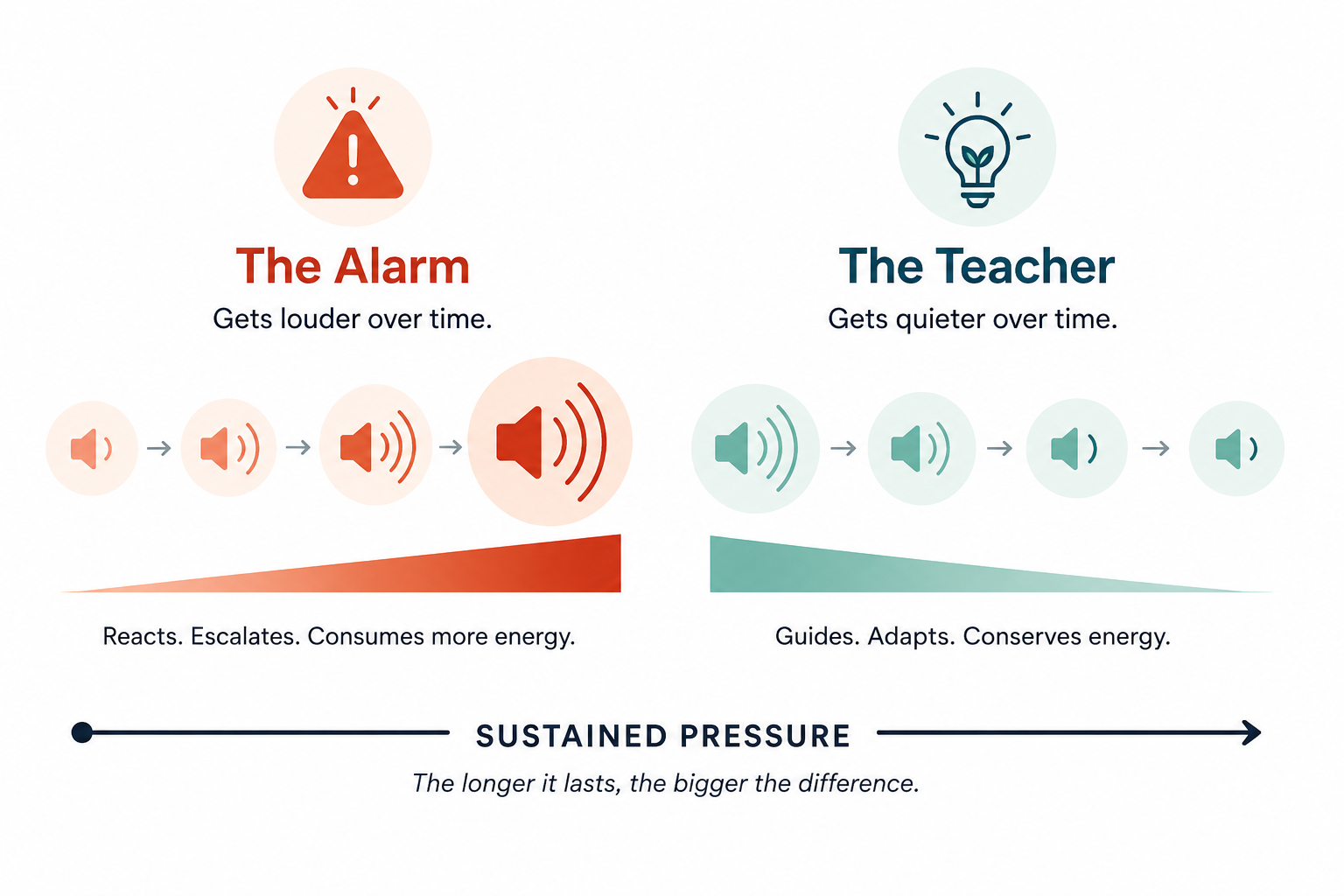
Chronic stress doesn't erase your personality. It narrows your access to it, by shifting your nervous system into a protective state that rations energy toward survival instead of connection.
Your brain runs two systems here. One works like a smoke alarm, built to detect danger fast. The other works like a wise teacher, the part of you that thinks clearly, feels warm, and stays genuinely present with people. Short bursts of stress let the alarm do its job without drowning out the teacher. Sustained stress is different. The alarm gets louder because your system keeps registering danger, and the teacher becomes harder to hear.
This isn't only happening in your head. Your nervous system constantly runs a background check on one question: are you safe? Researchers call this neuroception, the largely unconscious way your body scans for safety before you're even aware of judging it, part of the body's wider stress response system involving the sympathetic nervous system and the HPA axis. When the answer is yes, you have full access to yourself. When it's been no for long enough, your system shifts into protection mode, rationing your energy, narrowing what you feel, and redirecting resources away from connection and joy toward survival.
Longitudinal research tracking people's stress levels over time has found measurable links between sustained perceived stress and shifts in personality, including increased pessimism and reduced emotional stability. None of this is a character flaw. It's a nervous system doing exactly what it evolved to do under a load it was never designed to carry indefinitely, and because it responds to safety signals rather than willpower, you don't reverse it by forcing yourself back to who you were.
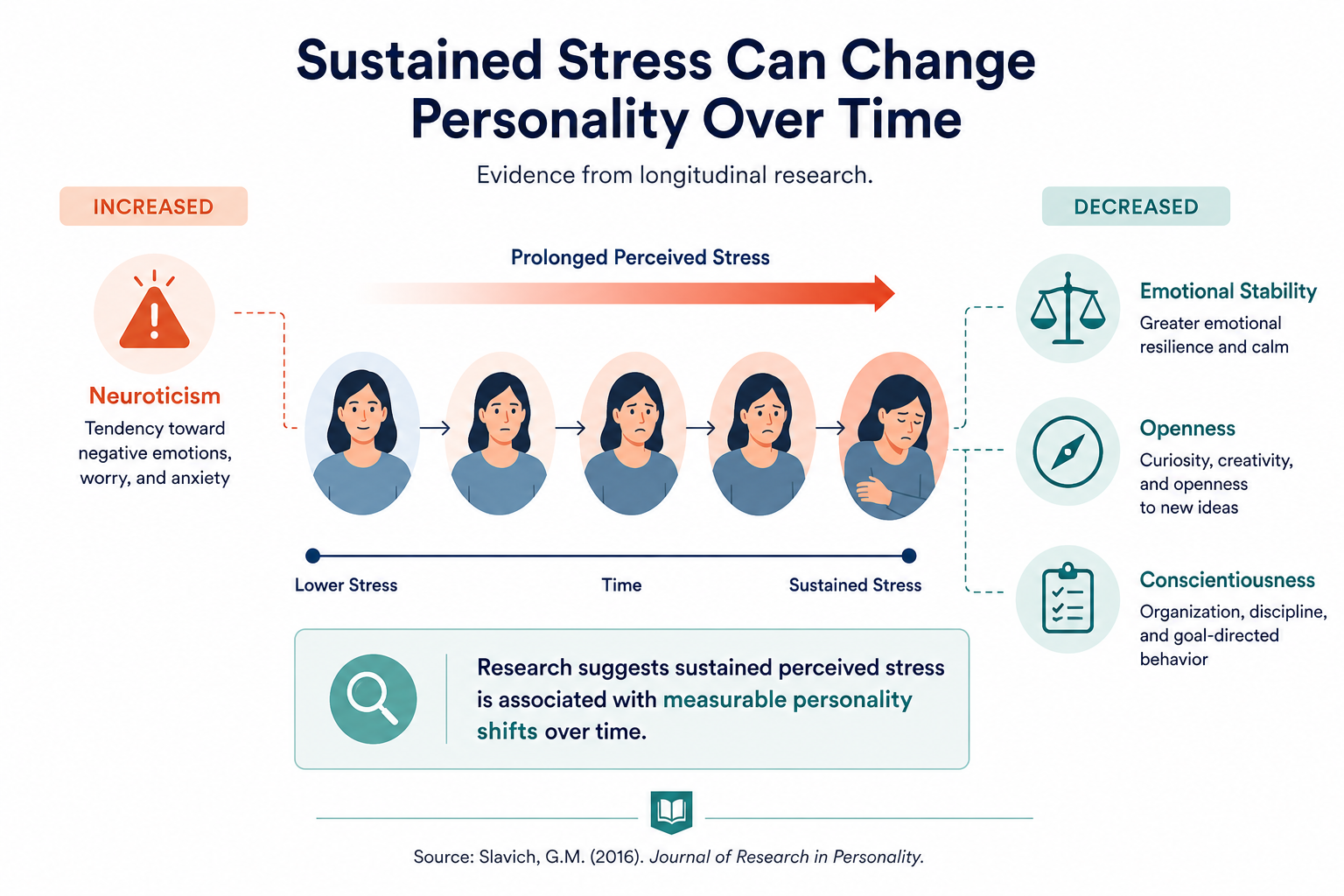
Why The People Who Cope Best with Stress Are Often the Ones Changing the Most
For people carrying real responsibility, stress rarely gets read as stress, because the coping mechanisms it produces tend to get praised rather than questioned. That praise is exactly what makes the personality shift so hard to catch.
Burnout doesn't always look like falling apart. Most of the people I work with are still leading teams, parenting, and showing up for everyone who needs them, while the change happens quietly beneath a smile they've learned to hold. The specific behaviours stress produces often get mistaken for virtues: higher standards that are really a nervous system trying to control what feels uncontrollable, focus that's really emotional avoidance, discipline that's really rigidity from a system hardened under pressure, independence that's really isolation because closing off feels safer than staying open, and busyness that's really an avoidance of stillness, because stillness is exactly where the alarm gets loudest.
These behaviours get rewarded. You become the reliable one, the always available one, the low maintenance one. But internally you've likely become less playful, less patient, less connected, and less trusting of your own instincts, and that combination is genuinely heavy to carry quietly. Recognising which of your own strengths might actually be a stress adaptation is often the first insight that opens the door to change.
What Meaning Fatigue Is, and Why it Hits Purpose Driven People Hardest
Meaning fatigue is what happens when the emotional labour of caring for others outpaces your capacity to recover from it, and it hits purpose driven people hardest because caring is usually the thing they've built their identity around.
People who carry a lot for others, whether that's a team, a family, clients, or a wider community, often learn to become whoever the room needs them to be, which isn't always who they actually are. Over years, that suppression compounds. For people who define their worth through contribution, caring less becomes the actual sign of how much stress they're carrying. The thing they identified with most starts to feel muted rather than energising, which can trigger something close to an identity crisis, because the caring wasn't just something they did. It was who they understood themselves to be.
People running on this stress chemistry for long enough start to believe it's simply who they've become, and they judge themselves for it on top of everything else. This is meaning fatigue: the erosion of the emotional resource behind caring, contribution, and connection, caused not by a lack of purpose but by carrying purpose without recovery for too long.
What Identity Grief is, and Why It Makes You Feel Unrecognisable to Yourself
Identity grief is the quiet mourning that happens when you sense you've lost touch with parts of who you used to be, even though nothing and no one has died. It's disorienting precisely because grief usually has a clear cause, and this version often doesn't.
It can become a lonely place when you can't work out who you are anymore, especially when the people closest to you seem not to recognise you either, because they're meeting your stress response and your mask before they meet the regulated version of you. Your state is contagious in ways you never intend. When you sense you've lost your humour, your softness, your optimism, or your ability to enjoy something without scanning for the next problem, there is real grief in that, even if nobody around you would call it grief. People often build a new identity around the loss instead, saying things like I've just become grumpy as I've aged, and shame gets layered on top of the stress underneath it.
I recognise this pattern because I lived a version of it. As a child, every time something confusing, painful, or cruel happened, I built a small wall around it, one quiet layer at a time, until those walls became a shell I mistook for my personality. I could articulate anything intellectually, but I'd lost the ability to feel what was underneath, to trust my own instincts, or to hear my own voice. My nervous system had learned that chaos was normal and pressure was safe, and it ran that programme so long I couldn't tell the difference between who I was and who I'd adapted to survive as. Prolonged stress doesn't just change how you feel. It changes how you move through the world until you stop noticing the gap between who you are and who you're being.
How You Actually Reverse Personality Changes Caused by Stress
Reversing this doesn't happen through more breathing exercises or removing a few tasks from your schedule. It happens by working at what I call the Root Level, the deepest layer of the Stress Performance Pyramid, where the actual behavioural patterns and safety signals sit underneath the visible stress.
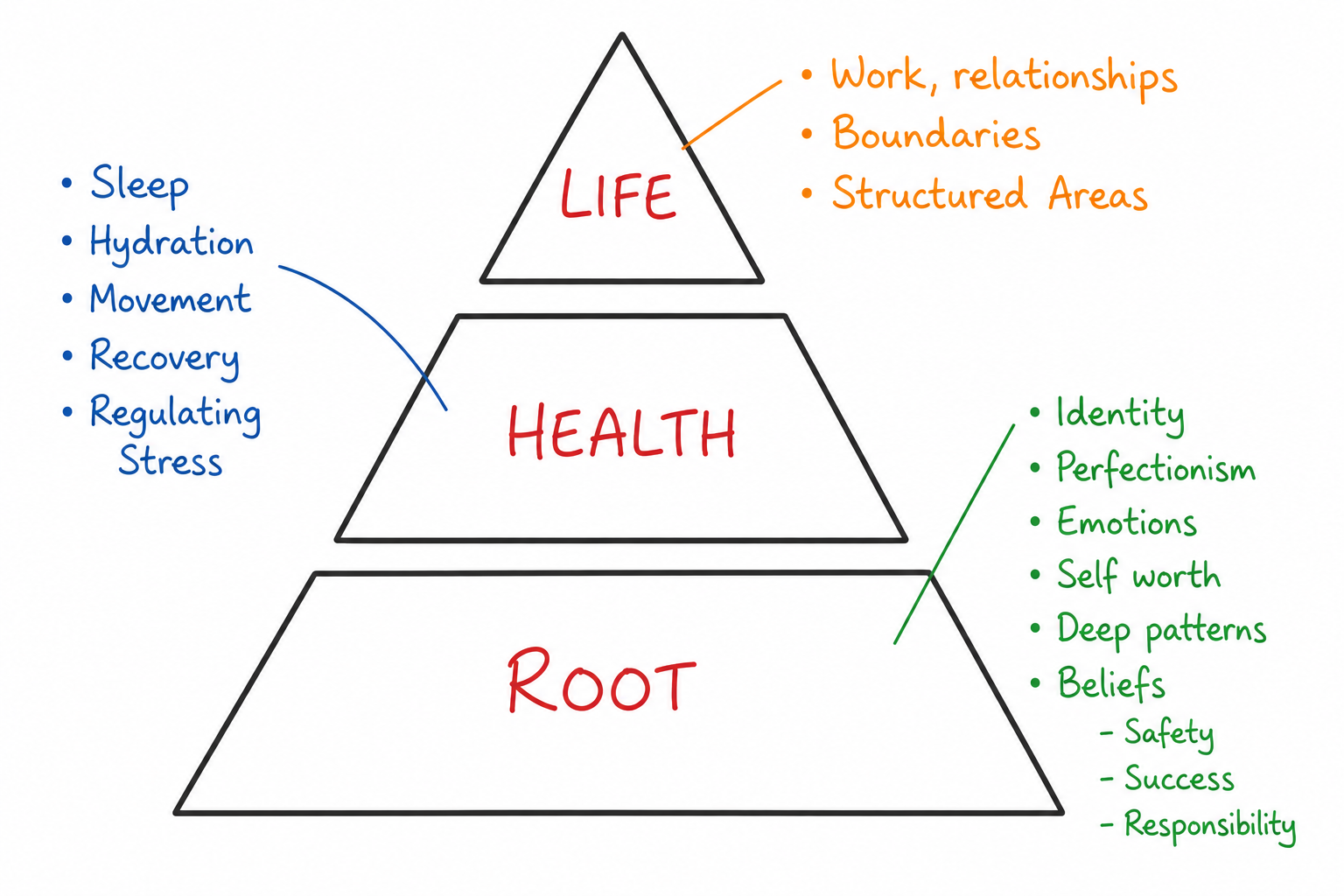
Most people reading this have already tried the accessible fixes: the books, the therapy, the meditation apps, the surface level work. None of that is wasted, but it works mostly at the Life Level, the visible circumstances and daily pressures. Lasting change requires going further, into the Health Level of your physical and nervous system responses, and into the Root Level, the behavioural patterns, values, and beliefs that keep the whole cycle running.
For one client, the starting point was realising she hadn't made a single decision based on what she actually wanted in over three years. Every choice had been shaped by keeping things stable for everyone else. The first safety signal we had to rebuild was permission. Her nervous system needed to learn it was safe to want something for herself again.
At the Root Level, this usually means asking what you're actually protecting yourself from, and what would genuinely allow you to feel at ease. It means noticing which of your coping mechanisms look admirable from the outside while quietly costing you on the inside, and getting honest about what you'd care about most if you had all the energy in the world.
You don't get your personality back by forcing yourself to be who you were before. You get it back by creating the conditions where you no longer need to protect yourself so intensely. The person underneath hasn't gone anywhere. She's simply been buried under protective patterns that made sense at the time, and when those conditions of safety rebuild, what comes back isn't the old you. It's a more evolved version of the person who was there all along.
Frequently Asked Questions
Can stress actually change your personality, or does it just feel that way?
It's genuinely real, not just a feeling. Sustained stress shifts your nervous system into a protective state that limits access to patience, warmth, and openness while amplifying irritability and withdrawal. Research has found measurable links between prolonged perceived stress and shifts such as increased pessimism, though the traits themselves haven't disappeared, they're just harder to access.
Why do the people who handle stress well often change the most underneath?
Because their coping mechanisms tend to get praised rather than questioned. Higher standards, sharper focus, independence, and constant busyness can look like strengths while actually functioning as control, avoidance, isolation, and an escape from stillness.
What is meaning fatigue and how is it different from normal tiredness?
Normal tiredness responds to rest. Meaning fatigue is the erosion of the emotional resource behind caring and contribution, caused by carrying others' emotional load for too long without genuine recovery, and it hits purpose driven people hardest because caring is central to their identity.
What is identity grief and why does it happen after prolonged stress?
Identity grief is the sadness that surfaces when you sense you've lost touch with who you used to be, even though nothing has actually died. Prolonged stress narrows your access to traits like humour, softness, and presence, and that loss produces a genuine, disorienting form of grief.
Is it possible to reverse personality changes caused by chronic stress?
Yes. The nervous system responds to safety signals, not just willpower, so the changes are reversible once the underlying conditions shift, usually by working at what the Stress Performance Pyramid calls the Root Level.
Why doesn't rest alone bring back who you used to be?
Rest addresses the Life Level, the visible pressures and circumstances, but personality changes caused by chronic stress usually live deeper, in nervous system patterns and Root Level beliefs about safety, worth, and responsibility.
You were never actually replaced by the stressed version of you. What you're calling your personality right now is a nervous system doing its job under a load it was never meant to carry indefinitely, and the real you is still there, waiting for the conditions that let it come back to the surface.
See Where Your Stress Patterns Are Sitting Right Now. Take a Free Stress-Less Scorecard
If you want a clearer picture of exactly where your own stress patterns are sitting, and how they might be shaping your personality without you fully realising it, the free Stress-Less Scorecard will show you in a few minutes. It maps your current patterns across the Life, Health, and Root levels of the Stress Performance Pyramid and gives you a clear, personalised starting point. There's no cost and no obligation, just a clearer view of what's actually happening beneath the surface.
About Charlotte Stebbing-Mills
Charlotte Stebbing-Mills is an award-winning wellbeing and performance expert with over 20 years of experience working with high performers, executives, and organisations across stress optimisation, burnout recovery, and sustainable high performance. She is the founder of The Wellness Theory and creator of the Stress-Performance Pyramid, the Well-Working Ecosystem, and the Ripple Effect Model.
Website: thewellnesstheory.com
Stress-Less Scorecard | Book an Exploration Call