
The Hidden Reason Burnout Follows You
You’ve done the things you were told to do. You took the time off. You said no more than you used to. You blocked out space in your calendar and, for once, actually kept it there. And a few months later you’re right back where you started: tired in a way sleep doesn’t touch, short with people you love, opening your inbox with a low hum of dread that used to only show up during the worst weeks. If you’re asking why does burnout keep coming back even when you’ve done everything right, here’s the honest answer. Burnout doesn’t return because you rested wrong or worked too hard again. It returns because rest changes your workload, not your nervous system’s setting for what counts as safe. Until that setting shifts, you’re always one demanding quarter away from the same collapse.
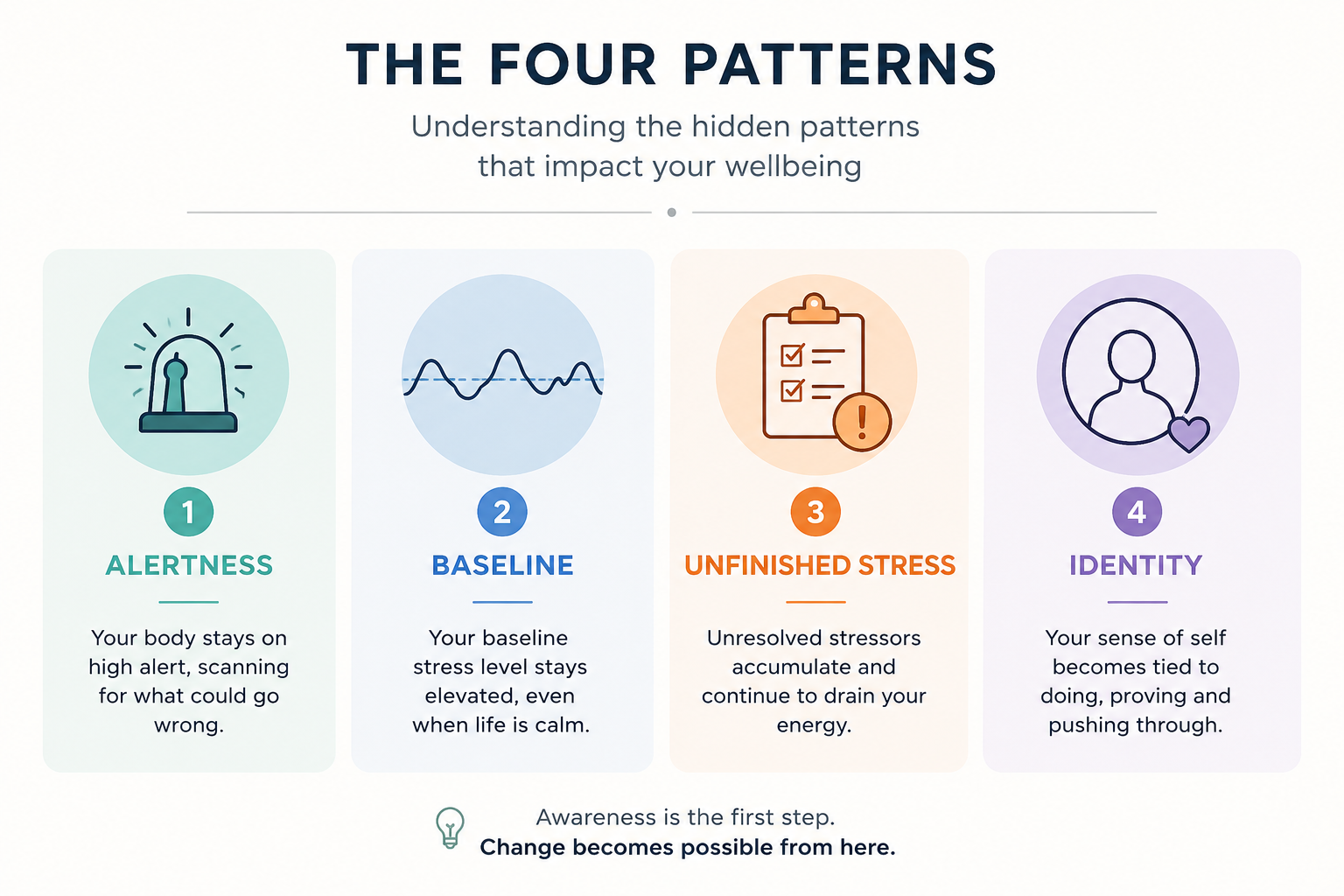
Why Rest Lowers Tiredness But Not Alertness
Rest reduces tiredness by letting your body recover from physical exertion. It doesn’t automatically lower alertness, which is a separate thing entirely: how ready your nervous system stays for the next demand, regardless of how much you’ve actually slept. Tiredness is depletion. Alertness is readiness. You can be exhausted and still wired, which is exactly why so many high achievers describe lying in bed with a heavy body and a mind that won’t stop scanning.
This is the pattern I’ve watched for over twenty years, first in cardiac patients recovering from heart attacks and strokes, now in founders and leaders carrying responsibility for teams and missions. The environments look nothing alike. The pattern underneath is identical. A system that has spent months or years staying ready to respond, ready to prove itself, ready to perform doesn’t stand down just because the calendar clears. It stayed switched on through the crisis. It stays switched on through the holiday too, unless something specifically teaches it that standing down is safe.
That’s usually the clearest answer to why burnout keeps coming back even after real time off: the workload changed, but the alertness underneath it never did. A week away changes what you’re doing, not how your body interprets stillness. For someone whose alertness has been running high for years, stillness can even register as unsafe, which is why the second day of a holiday sometimes feels worse, not better.
If alertness stays high, the tiredness always comes back, because the thing driving it was never actually addressed.
Why Your Stress Baseline Keeps Creeping Upward
Your stress baseline is the resting level of activation your nervous system treats as normal, the point it drifts back to whenever nothing urgent is happening. For most high achievers, that baseline has been climbing for years without anyone noticing, because the climb happens gradually and the system adapts at every stage.
Here’s what that adaptation looks like. Deadlines, expectations and responsibility stop registering as pressure and start registering as background noise. You stop consciously feeling the activation because it has become the default. Researchers studying what’s known as allostatic load, the cumulative wear from repeated stress activation, have shown that a nervous system exposed to sustained demand recalibrates its own definition of normal (Juster, McEwen and Lupien, 2010). Once that recalibration happens, calm doesn’t feel calming anymore. It feels unfamiliar, sometimes even uncomfortable, which is why so many clients tell me a quiet Sunday makes them more anxious than a packed one.
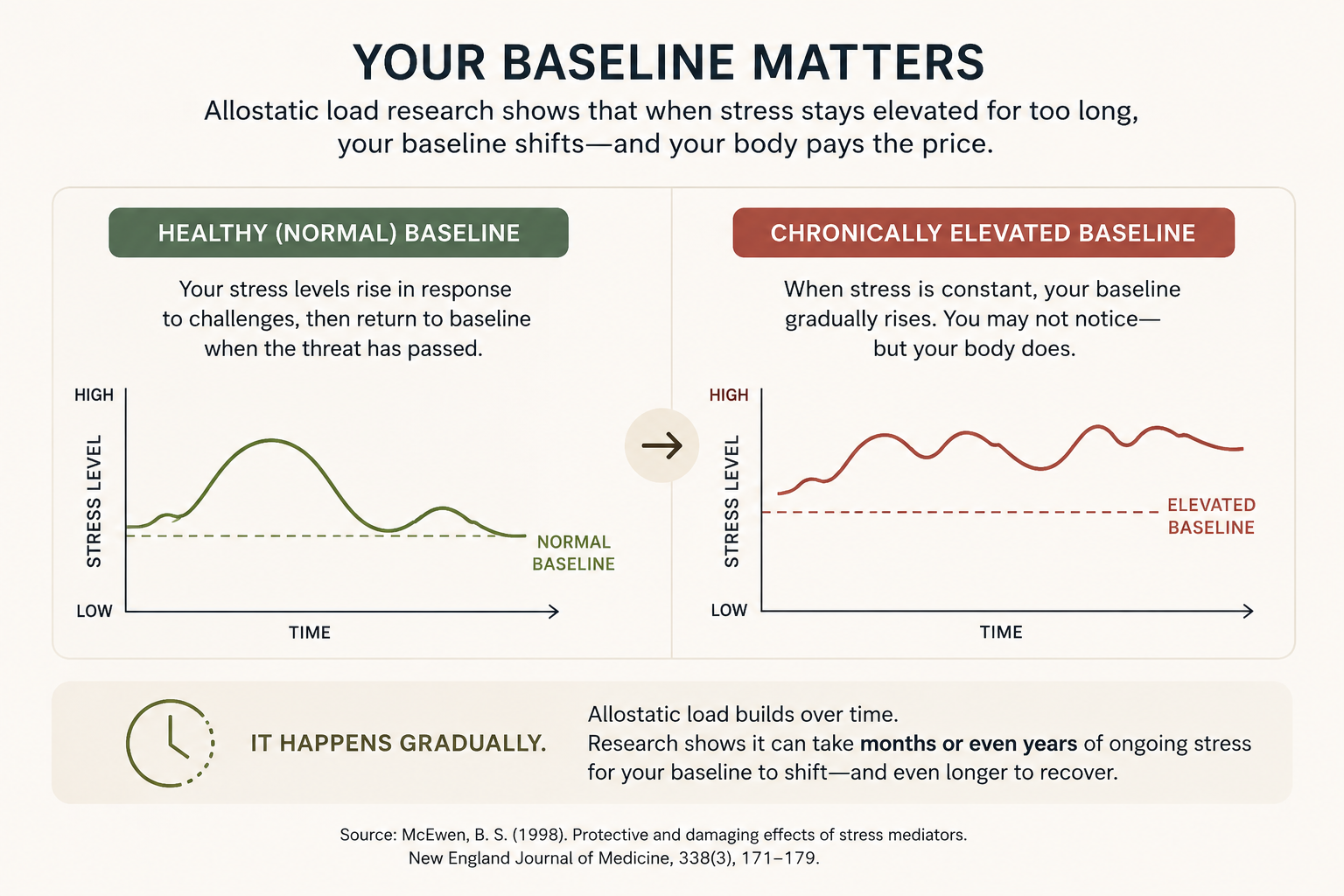
This is why burnout so rarely looks sudden from the inside. It’s accumulated activation, quarter after quarter, in a system that was never given a reason to reset, which is precisely why burnout keeps coming back long after the workload that caused it has disappeared.
The job isn’t to push through a higher baseline more efficiently. It’s to actually lower it, so your system has a genuine floor to return to instead of a permanently raised one.
Why Unfinished Stress Stacks Instead of Clearing
Finishing a task and finishing the stress it created are two different events, and most of us only ever complete the first one. You hit the deadline. You handled the crisis. The project closed out. But your body doesn’t automatically process the activation that built up while you were carrying it, and if that activation isn’t discharged, it doesn’t just fade on its own.
Picture it like browser tabs left open in the background. Nothing looks urgent on the surface, but every open tab is quietly using up capacity, and eventually the whole system slows down. That’s what unfinished stress does inside the body. It stacks, week after week, quarter after quarter, until the accumulated load starts showing up as exhaustion, irritability or the kind of flatness that no single event fully explains.
This matters because it changes what recovery actually requires. According to the American Psychological Association, 2023, chronic activation of the stress response keeps the body in a near constant state of physical guardedness, rather than releasing tension the way it would after a single acute stressor. Completing stress isn’t about thinking your way out of it. It’s a physical process, and skipping it is a large part of why burnout keeps returning months after the original problem is long gone.
Why Your Identity Ties Safety to Performance
This is the layer most high achievers miss entirely, and it’s the one that actually determines whether burnout keeps repeating. Somewhere along the way, your nervous system stopped treating performance as something you do and started treating it as something that keeps you safe. Slow down, and a quiet alarm goes off that has nothing to do with logic and everything to do with identity.
I call this the Root Level of the Stress-Performance Pyramid, the framework I use with clients to map exactly where their stress is actually coming from. Life Level stress is the visible pressure: the deadlines, the responsibilities, the things you could point to on a calendar. Health Level stress is what that pressure does to your body and emotions. Root Level stress is the deepest layer, the behavioural patterns and identity conditioning that keep the whole system activated regardless of what your schedule says. Most advice only ever touches the Life Level. That’s why it doesn’t hold.
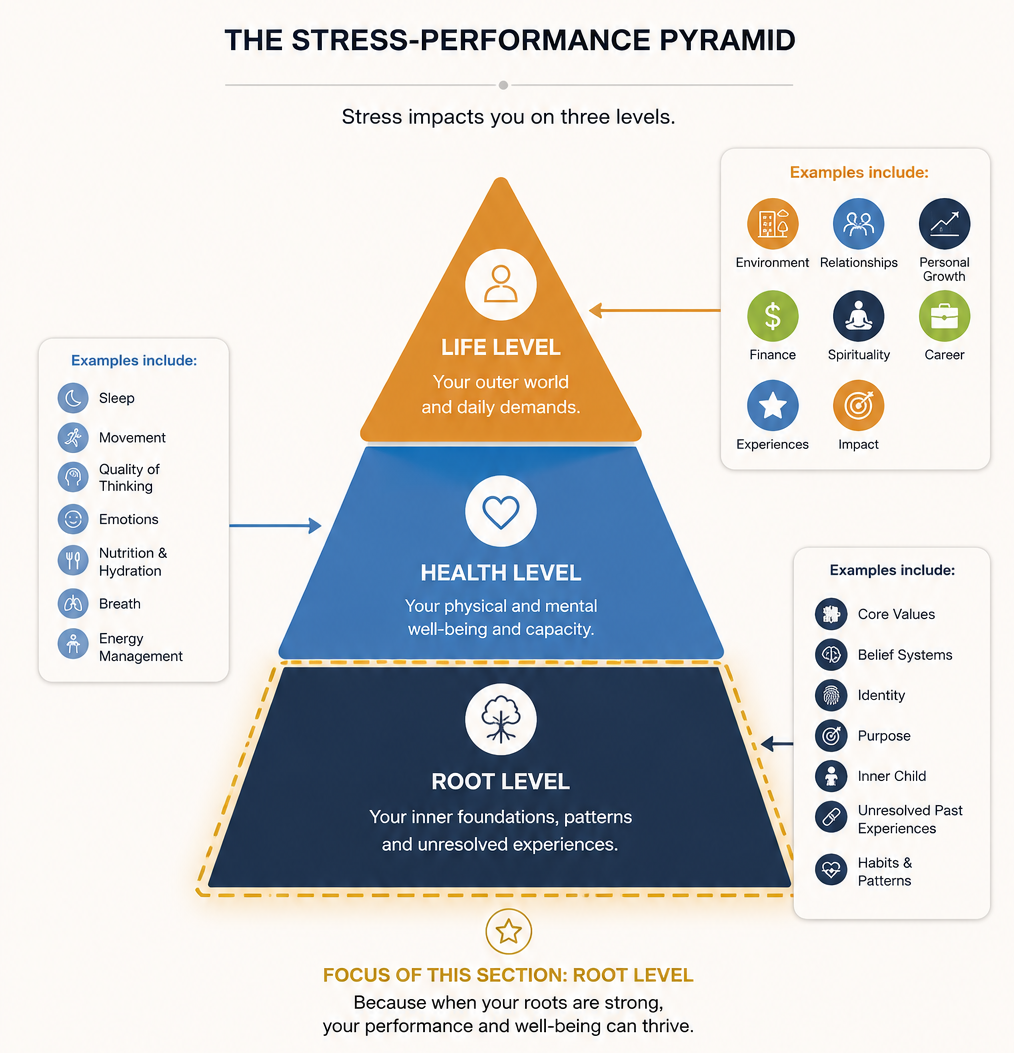
At the Root Level, safety and performance get fused together. You over deliver, hold everything together, keep proving yourself, not because you enjoy it but because some part of you believes that if you stop, something falls apart. That belief doesn’t announce itself. It just quietly overrides every intention you have to rest. Until your identity separates safety from output, every attempt to slow down will keep feeling like a risk instead of a relief.
Frequently Asked Questions
What’s the difference between resting and recovering?
Resting is stopping activity so your body can recover from physical exertion. Recovering is different: it’s the process of teaching your nervous system that it’s genuinely safe to lower alertness, not just reduce output. You can rest for two weeks and still not recover, because rest addresses fatigue while recovery addresses the activation underneath it. That’s why a holiday can leave you feeling just as wired as before it started.
Why does burnout come back after therapy or coaching that helped at the time?
Therapy and coaching often work at the Life Level or Health Level of stress, helping you understand your circumstances or manage your emotional responses more effectively. If the Root Level pattern, the belief that safety depends on performance, never gets addressed, your nervous system keeps defaulting back to its old setting once the support ends. The insight was real. It just didn’t reach the layer that was actually driving the cycle.
What does it actually mean for stress to be completed?
Completing stress means letting your body finish the physiological response it started, rather than stopping at the point where the task itself is finished. A deadline can end while the stress it generated is still fully active in your system. Movement, genuine rest, emotional expression and real time away from output all help signal to your body that the demand has passed, not just the task.
How do I know if my stress baseline has crept up without me noticing?
A rising baseline usually shows up as calm feeling unfamiliar rather than restful. If stillness makes you anxious, if a quiet weekend feels harder to get through than a busy one, or if you genuinely cannot remember what relaxed used to feel like, your baseline has likely shifted upward without you registering it happening.
Can burnout happen even when my workload looks manageable on paper?
Yes, and this is one of the most common patterns among high achievers. Burnout isn’t purely a function of hours worked. It’s a function of how long your system has believed it needed to stay switched on. Someone with a reasonable workload and an identity fused to performance can burn out just as thoroughly as someone working sixty hour weeks.
What actually helps with burnout recovery long term?
Long term recovery means working at the Root Level, changing the belief that safety depends on output, not just changing your calendar. That means building real nervous system regulation, addressing the identity patterns that keep you performing past depletion, and giving your body genuine opportunities to complete stress instead of simply pausing it.
Burnout was never really caused by how much you worked. It was caused by how long your nervous system believed it had to stay switched on. You can reduce your workload, take the time off, and restructure your entire calendar, and if your body still believes slowing down is unsafe, you’ll keep returning to the same overdrive. That’s the real answer to why does burnout keep coming back for so many high achievers who have genuinely tried everything sensible: the schedule changed, but the system underneath it never did. Burnout stops repeating the moment safety actually replaces survival, not when your calendar changes but when your nervous system does.
Take a Free Stress-Less Scorecard
If you want to know whether your own system is still running on survival rather than safety, the free Stress Less Scorecard is the fastest way to see it clearly. It takes less than three minutes, and it will show you whether you’re still fixing burnout the old way, focused on workload and willpower, or actually addressing the pattern underneath it. You’ll walk away with a clear picture of where your stress is really coming from and what would genuinely change it.
About Charlotte Stebbing-Mills
Charlotte Stebbing-Mills is an award-winning wellbeing and performance expert with over 20 years of experience working with high performers, executives, and organisations across stress optimisation, burnout recovery, and sustainable high performance. She is the founder of The Wellness Theory and creator of the Stress-Performance Pyramid, the Well-Working Ecosystem, and the Ripple Effect Model.
Website: thewellnesstheory.com
Stress-Less Scorecard | Book an Exploration Call