
Why High Performers Get Addicted to Stress
There’s a version of exhaustion that doesn’t look like exhaustion at all. You’re still hitting deadlines, still leading the team, still the one everyone else leans on. But underneath the performance, something has shifted. You feel sharper the moment pressure arrives and strangely flat the moment it lifts, and you’ve told yourself this is just what drive looks like. It isn’t. In twenty years of working with high achievers, founders, and changemakers, I’ve learned that why high performers get addicted to stress has almost nothing to do with ambition and almost everything to do with chemistry. Your nervous system has learned that pressure produces a specific mix of reward chemicals, and it has quietly started treating that mix as the thing that makes you feel capable, needed, and alive. This isn’t a character flaw. It’s a pattern you can actually see, name, and change once you understand exactly how it works.
Why Pressure Becomes Dependence Rather Than Ambition
Pressure turns into dependence the moment your nervous system starts using it to regulate how you feel, not just to get things done. Most high performers never question this shift because it hides inside something that looks like a strength.
I worked with a client running two businesses, mentoring his team, and leading community projects on the side. On paper, everything looked strong. Underneath, he couldn’t stop. He told me, when I’m still, I feel like I’m disappearing. His body was already signalling clearly: a tight chest, disrupted sleep, digestive issues he’d stopped mentioning to anyone. He’d open his laptop anyway and push through, calling it dedication. What was actually happening was dependence. His nervous system had learned to rely on pressure to feel like himself.
This is what I’d call a Root Level pattern in the Stress-Performance Pyramid, the framework I use with clients to map where stress is genuinely operating. Most people only address the Life Level, the visible workload and deadlines sitting on the surface. But dependence on pressure is conditioning that sits underneath that, in the deeper behavioural patterns keeping the whole system switched on. Right before burnout, I consistently see three things get reframed as virtues: sleep disruption gets called a mind full of ideas, increased urgency gets called ambition, and the loss of genuine recovery gets called normal. What looks like drive on the surface is often a system that has learned to depend on pressure to function at all.
What the DOSE Loop Is and Why Stress Feels Chemically Rewarding
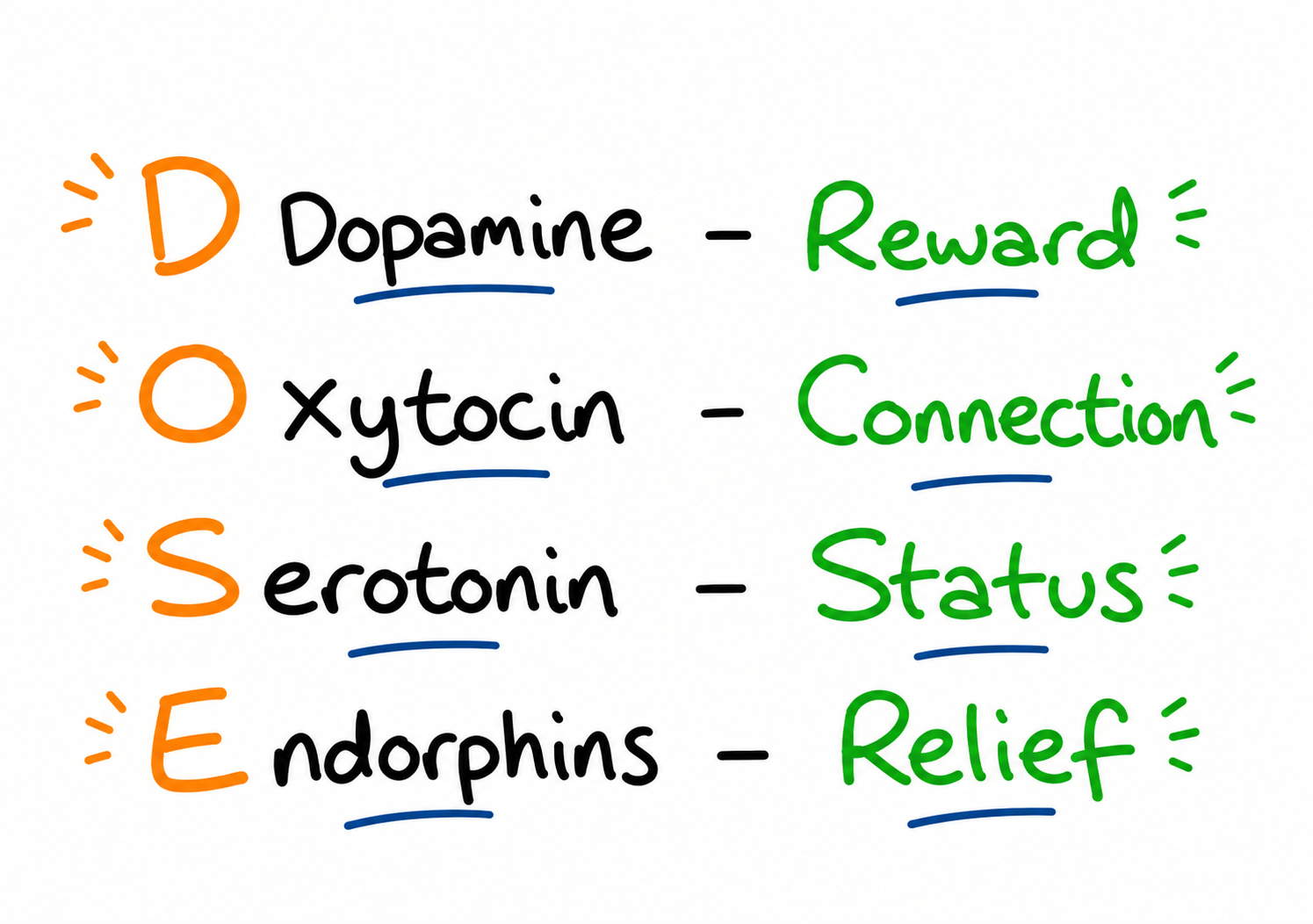
The DOSE loop is the chemical mix your brain releases under pressure, made up of dopamine, oxytocin, serotonin, and endorphins, and it explains why stress can feel rewarding long before it becomes exhausting. This isn’t just a psychological pattern. It’s biological, and once you can see the mechanism, the pull of pressure stops feeling mysterious.
Dopamine is released when you hit a goal, and it feels genuinely good, which is exactly the problem. Harvard Health describes dopamine as central to the brain’s reward and motivation system, meaning the high fades fast and your brain starts chasing the next hit rather than resting in the last one. Oxytocin works differently. It’s released through connection and being needed, so helping others lights up the exact same reward circuitry, and if you’re overextending to feel useful, you can end up burning out in the name of service. Serotonin brings a sense of status and control, so striving to be indispensable starts to feel like the only way to feel secure. Endorphins are the most easily missed. Sometimes people unconsciously create pressure or pain just to earn the relief that follows it.
Research from Yale neuroscientist Rajita Sinha shows that chronic stress activates reward pathways in ways that closely resemble the mechanisms seen in addiction, and the American Psychological Association confirms that sustained stress creates measurable changes in the brain and body well beyond what most people associate with simply feeling busy. None of this is addiction to a substance. It’s addiction to stimulation, urgency, and the feeling of being essential, and your brain has quietly learned that pressure equals reward.
Why Calm Starts to Feel Unfamiliar
Calm starts to feel unfamiliar once pressure has become identity rather than circumstance, because stopping now threatens something deeper than your schedule. This is the stage where stress gets relabelled as discipline, ambition, responsibility, and resilience, and where it becomes genuinely hard to tell adaptation from advantage.
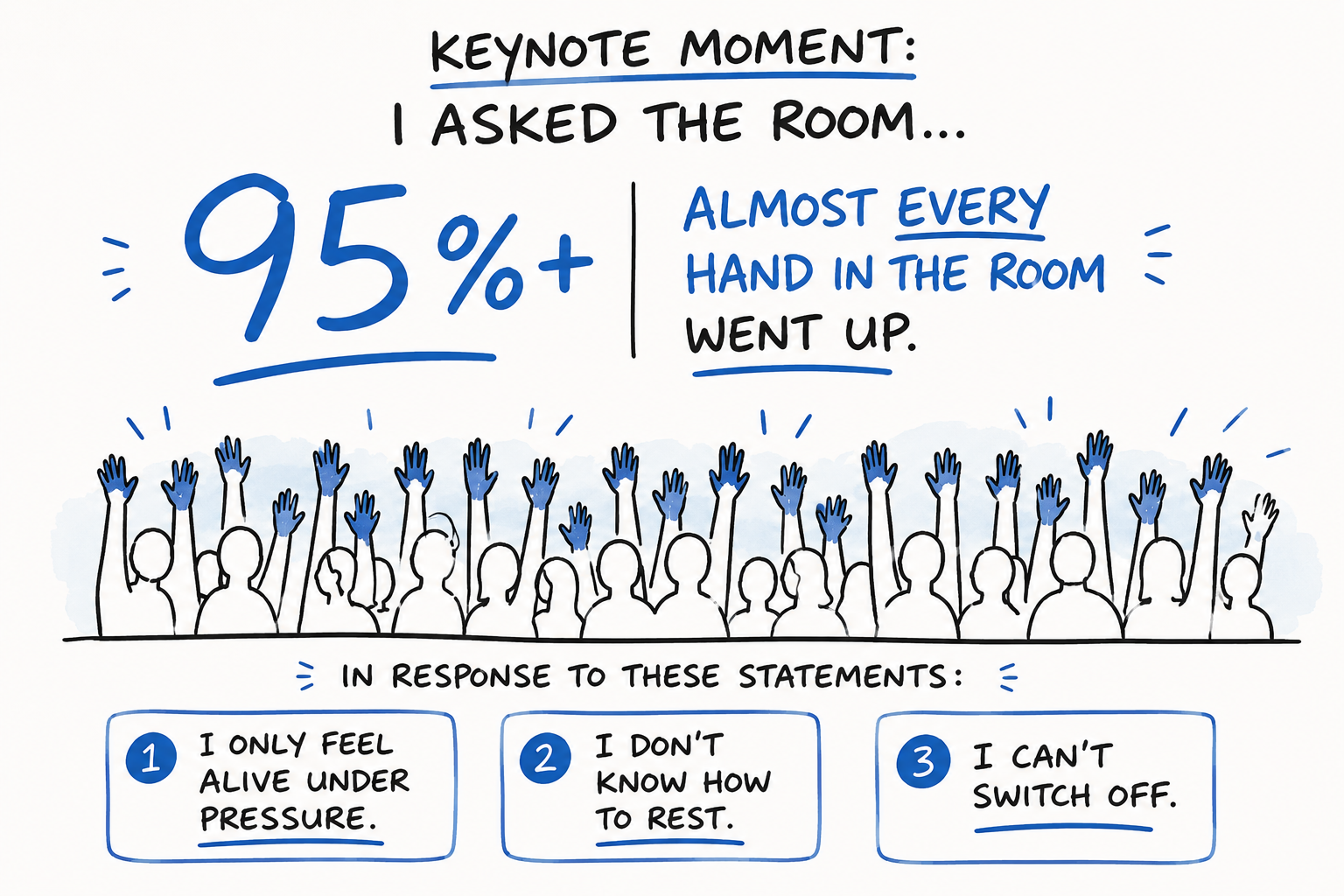
I was delivering a keynote to over three hundred founders and leaders recently, and I asked them to raise a hand if any of the following felt true: I only feel alive under pressure, I don’t know how to rest, I can’t switch off. Almost every hand in the room went up. That isn’t personality. That’s conditioning, built slowly enough that nobody notices it happening.
The deeper belief worth challenging here is the assumption that success comes from stress. Ask yourself honestly: if pressure disappeared tomorrow, would you feel fulfilled, or would your system feel lost? That answer tells you almost everything about which one you’re actually running on. Your biology rewards pressure. Your future requires capacity, and those two things are not the same currency.
How to Tell If You’re Relying on Stress to Perform
You’re likely relying on stress to perform if you feel wired but not awake, exhausted but unable to stop, or productive without ever feeling present, because these are the exact fingerprints of a system running on reward chemistry rather than genuine capacity.
High performers rarely burn out because they lack the ability to handle stress. They burn out because they’ve learned to need it. The tell isn’t how much you’re getting done. It’s what happens the moment the pressure lifts. If stillness feels like relief, your system still has access to genuine rest. If stillness feels like disappearing, like something is quietly wrong, or like you need to manufacture the next deadline just to feel like yourself again, that’s dependence talking, not drive.
Frequently Asked Questions
Is stress addiction real, or is it just another way of describing ambition?
It’s real, and it’s distinct from ambition. Ambition is a choice you make toward something you want. Stress dependence is your nervous system using pressure to regulate how you feel, which means the drive continues even when the goal itself no longer matters. The chemistry behind it, the same dopamine and cortisol pathways implicated in other reward based behaviours, is well documented in stress research, not just a metaphor borrowed from addiction language.
Why do I feel restless or on edge the moment things finally go quiet?
Because your nervous system has been calibrated to treat urgency as safety. When the external pressure disappears, the internal activation doesn’t switch off immediately, so stillness can feel unfamiliar or even threatening rather than restful. This is a conditioned response, not a personality trait, which is exactly why it can be retrained.
What’s the actual difference between drive and dependence?
Drive moves toward something meaningful and can rest without falling apart. Dependence needs pressure just to feel functional, regardless of whether the task in front of you actually matters. One question usually reveals which one you’re running: if the deadline disappeared tomorrow, would you feel relief or panic?
Can I be highly productive and still be dependent on stress?
Yes, and this is precisely what makes the pattern so easy to miss. Output is often the last thing to decline. Dependence shows up first in sleep, patience, presence, and your ability to genuinely switch off, long before it ever touches your performance at work.
Does this mean my ambition itself is the problem?
No. Ambition isn’t the issue, and you don’t need to want less. The issue is a nervous system that has learned to equate pressure with worth and reward, which means you can keep your drive while changing what’s actually fuelling it.
What’s the first step to breaking a stress dependence pattern?
Start by noticing what happens in your body the moment pressure lifts, rather than immediately filling the space with the next task. That gap, uncomfortable as it feels at first, is where you begin teaching your system that safety and stillness can coexist again.
Stress can be chemically rewarding, and that’s exactly why high performers become dependent on it without ever realising what’s happened. This isn’t about willpower or trying harder to relax. It’s about a nervous system that learned, over years of real responsibility, that pressure equals reward, and calm equals risk. The shift isn’t learning to want less. It’s learning to perform without needing the chemistry of pressure to do it, because pressure can build performance, but only capacity sustains it.
Take a Free Stress-Less Scorecard
Most high performers try to work this out alone, and if you’re recognising yourself in what you’ve just read, especially if you’re someone other people depend on, I’d invite you to book a private exploration call. This is where we decode your stress patterns, understand your actual capacity, and get clear on whether you’re operating from dependence or from sustainable performance. If we’re a fit, I’ll show you the next steps. If we’re not, you’ll still leave with genuine clarity.
About Charlotte Stebbing-Mills
Charlotte Stebbing-Mills is an award-winning wellbeing and performance expert with over 20 years of experience working with high performers, executives, and organisations across stress optimisation, burnout recovery, and sustainable high performance. She is the founder of The Wellness Theory and creator of the Stress-Performance Pyramid, the Well-Working Ecosystem, and the Ripple Effect Model.
Website: thewellnesstheory.com
Stress-Less Scorecard | Book an Exploration Call