
Your Body Warns You Before Burnout (What Most Miss)
You're still showing up. Still delivering. Still the person everyone counts on. But something has shifted, and you can't quite name it. Recovery takes longer than it used to. A full night's sleep doesn't leave you feeling rested. Your gut has been off for weeks. There's a tension sitting in your jaw or your shoulders that never fully releases, even on a quiet weekend. You've probably explained it away: too much coffee, a hard month, getting older. In over twenty years of working with high performers, from founders and executives to NHS teams and leaders carrying entire organisations, I've learned that these are usually the early signs of burnout, and they show up in the body months before performance ever visibly drops. This isn't about doing too much. It's about your nervous system trying to get your attention long before it forces you to stop.
Why Burnout Starts as a Whisper, Not a Crash
Burnout doesn't begin the day you collapse. It begins the day your body starts compensating, quietly, for a load it can no longer absorb without a cost. Most people wait for a shout before they take stress seriously: the breakdown, the diagnosis, the moment they physically cannot get out of bed. But the body whispers long before it shouts. First through tension and a background sense that something feels off. Then through disrupted sleep. Then through energy that no longer stretches across a full day the way it used to.
This is exactly what I map in the Stress-Performance Pyramid, the framework I use with clients to understand how stress actually moves through a person. At the Life Level, you see the visible pressures: the deadlines, the responsibilities, the packed calendar. At the Health Level, you see the physical and emotional response to carrying that load: the tight chest, the gut irritability, the wired but tired feeling that won't lift. At the Root Level sit the deeper patterns, identity and conditioning, that keep the whole cycle running. Most people, and most conventional stress advice, only ever address the Life Level. But the early signs of burnout almost always surface at the Health Level first, weeks or months before anything at the Life Level visibly breaks.
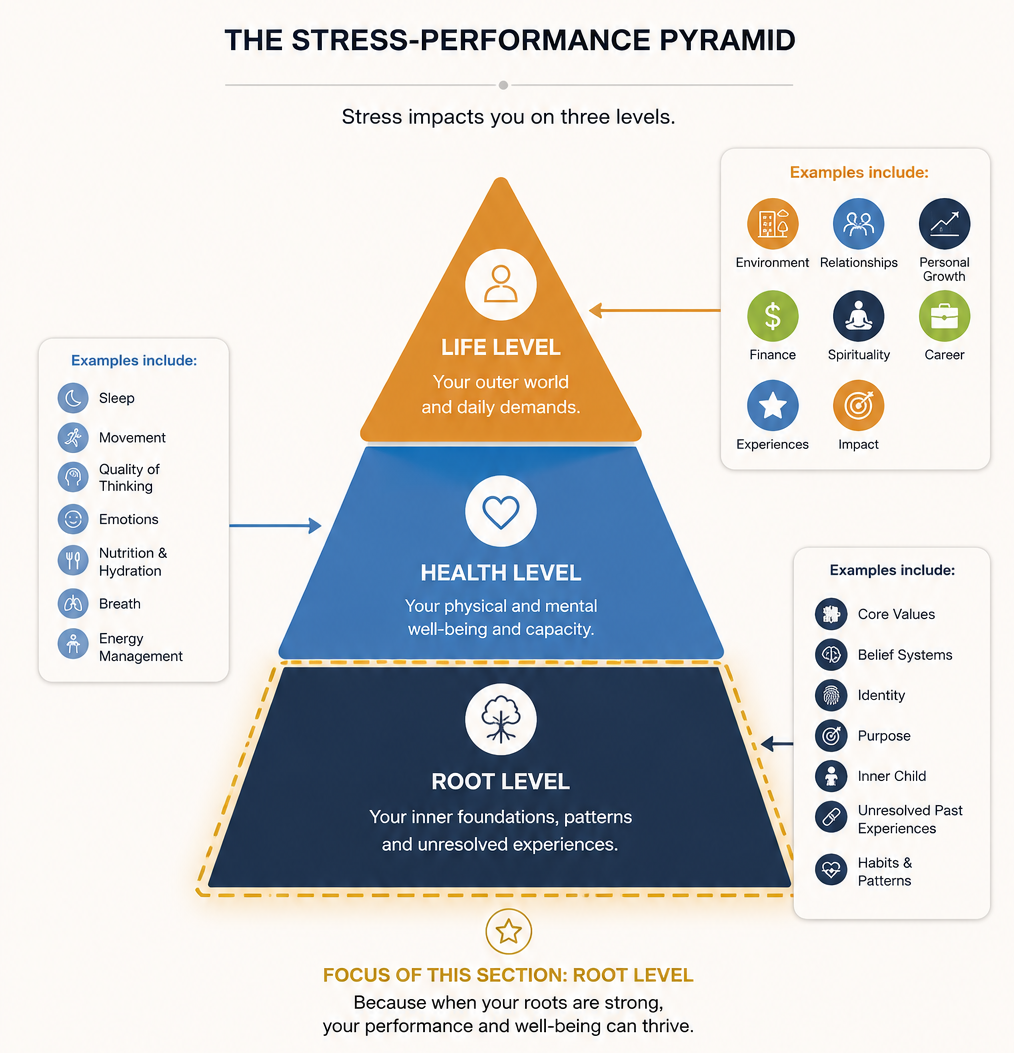
The World Health Organization defines burnout as a syndrome resulting from chronic workplace stress that hasn't been successfully managed, marked by exhaustion, growing mental distance from your work, and reduced effectiveness. That definition confirms what the body already knows: burnout is a process, not an event, and it signals throughout that process, not just at the end of it.
Why High Performers Override Their Own Warning Signals
High performers are exceptionally good at overriding discomfort. It's often the very trait that made them successful. We call it discipline. Underneath, it's frequently disconnection. Stress gets mistaken for commitment. Fatigue gets normalised. Tension becomes background noise you've simply stopped registering.
This is what I call signal blindness. It's the specific pattern where the same capacity that makes someone excellent under pressure, the ability to push through discomfort without letting it show, is also what disconnects them from the very signals their body is sending to protect them. Because performance is still holding, the signals get dismissed. Right before burnout, I consistently see the same three things happening together: more pushing, less recovery, and early physical signals being quietly explained away.
I worked with a client who was extremely successful financially, highly respected, with a strong work ethic that had carried him for years. Physically, he was struggling to fall asleep and then waking at 2am. His gut was irritable. Anxiety spiked at costly moments in his day, and his energy crashed reliably at the same points each afternoon. His belief was simple: this is just what success requires. It wasn't dramatic at first. But performance started slipping in small ways, more rework, less clarity, shorter patience. Once we reframed his stress as a performance issue rather than a resilience issue, recovery stopped feeling like weakness and became strategy instead.
High performers rarely burn out purely from pressure. They burn out from staying disconnected from their own signals for too long. The American Institute of Stress documents physical stress symptoms spanning nearly every system in the body, from tension headaches and gut issues to disrupted sleep and a weakened immune response, which is exactly why these signals so often get misread as separate problems rather than one connected pattern.
Why Your Body Overflowing Isn't a Sign Something's Broken
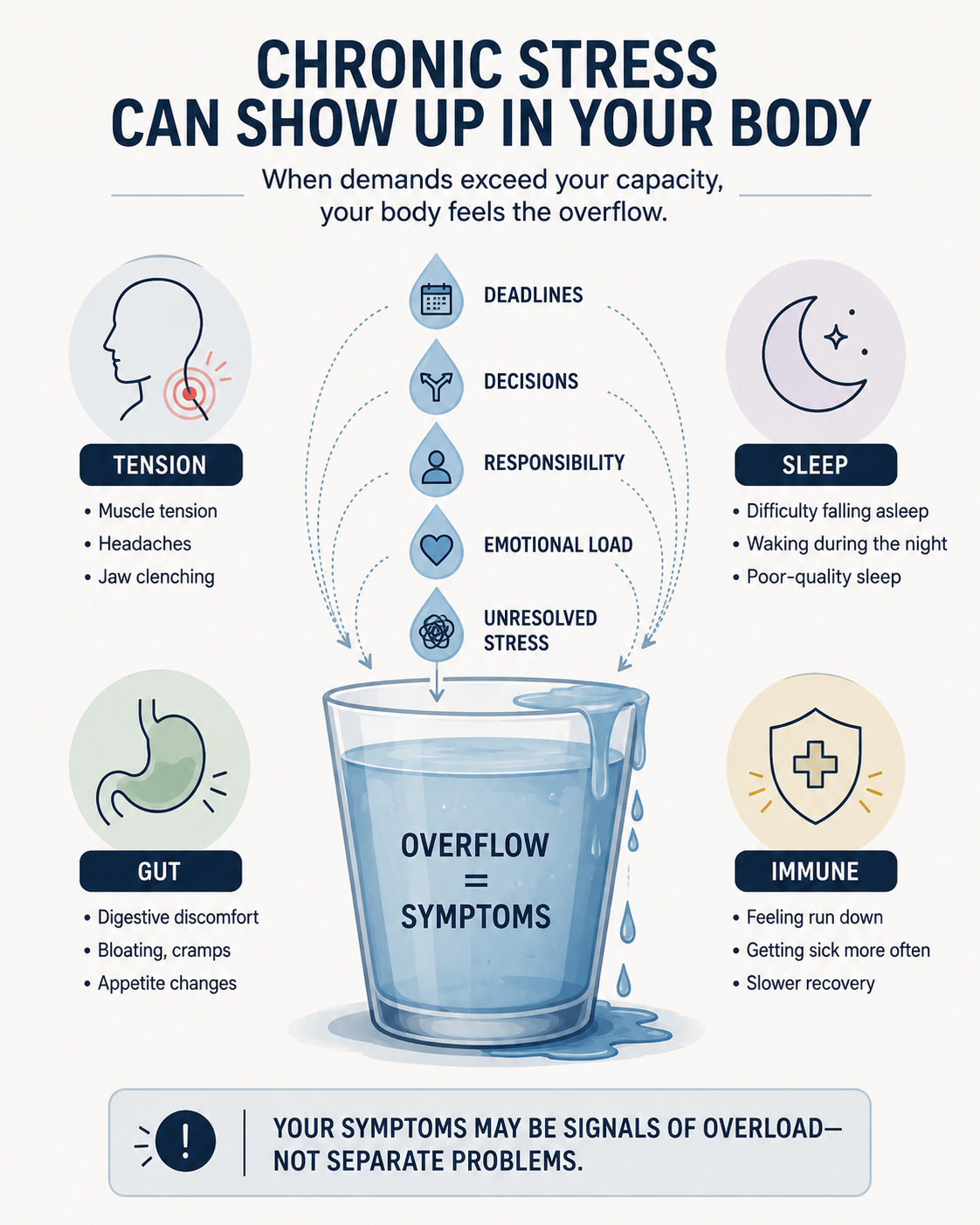
Symptoms don't usually mean something is wrong. More often, they mean you're at full capacity. One of the most common mistakes I see high performers make is treating each symptom as its own isolated problem. Fix the sleep. Fix the gut. Fix the anxiety. Each one gets handled separately, and the real pattern underneath, that all of these symptoms are coming from the same overload, gets missed entirely.
Think of your system like a glass. Every pressure adds a drop: decisions, deadlines, responsibility, emotional load, unresolved stress. Nothing obvious happens for a long time. Then, without warning, it overflows. The overflow becomes the symptoms. Not because something inside you has broken, but because your capacity has been exceeded.
I once worked with a leader in a high pressure role, capable and highly respected, who started experiencing random heart palpitations. Medical tests came back completely clear. What was actually happening was years of accumulated pressure without full system recovery. When we mapped his load properly, it wasn't one problem. It was accumulation, arriving all at once through whichever system happened to give way first. Once we reduced the overall load and rebuilt his recovery rhythm, the symptoms genuinely eased. The NHS is clear that experiencing severe or prolonged stress can lead to physical, mental and emotional exhaustion, which is often what people mean when they describe burnout. Your body overflowing isn't a sign something is wrong with you. It usually means you're carrying more than your current capacity allows, without enough recovery to balance it.
How the LISTEN Method Works
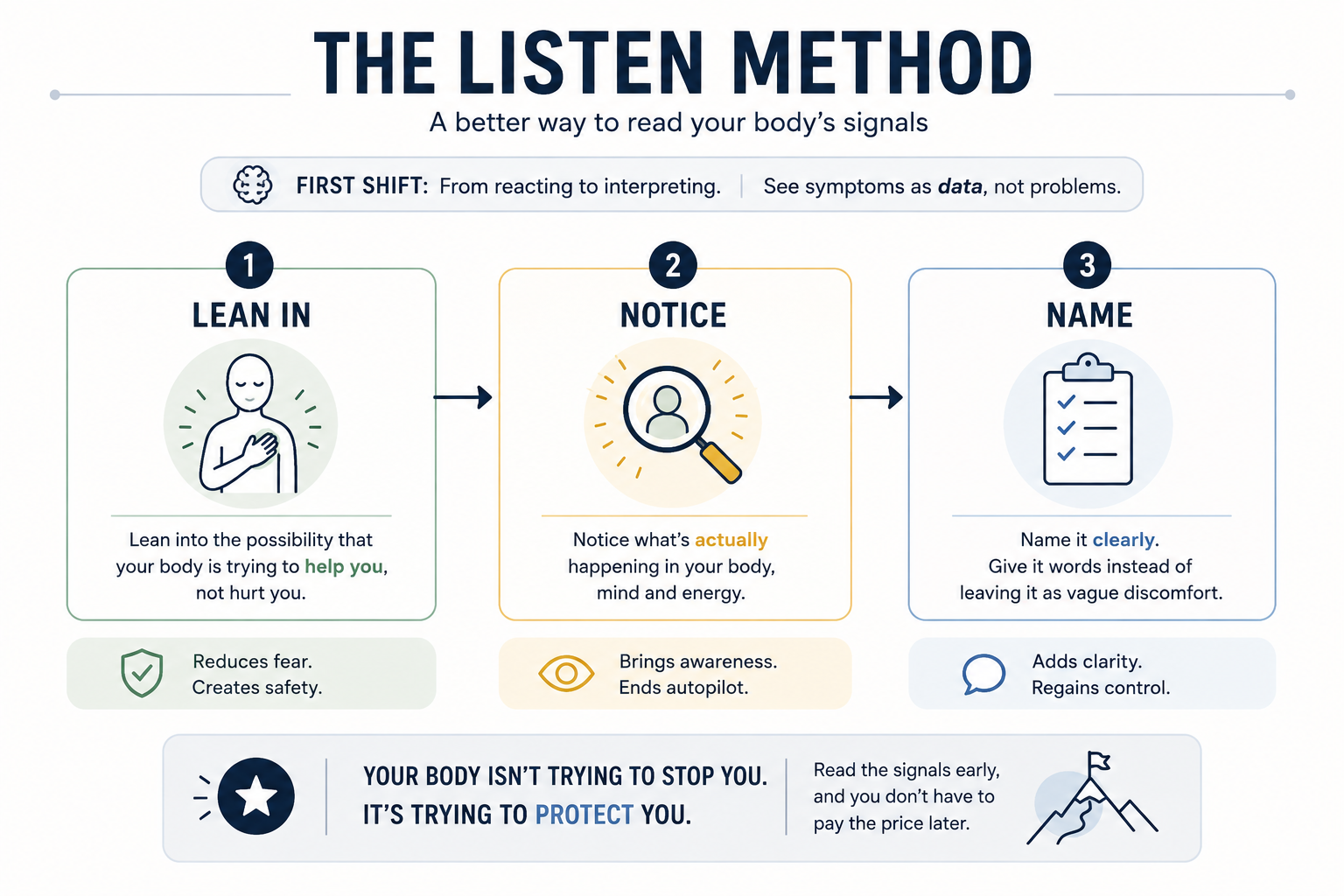
The first shift isn't behavioural. It's interpretive. Most people see a symptom and immediately treat it as a problem to eliminate. High performers benefit far more from treating it as data. You cannot recover from burnout while you're also stressed about the symptoms of your stress, so the starting point has to be a change in how you read the signals in the first place.
This is the foundation of what I teach clients as the LISTEN method. The first move is to lean in, rather than push away. Lean into the possibility that your body is trying to help you, not hurt you, which immediately removes a layer of fear around the symptoms themselves. From there, the practice is simple: notice what's actually happening, and name it clearly, instead of letting it sit as vague, unexamined discomfort. Your body isn't trying to stop you. It's trying to protect you.
I had a client once tell me, “I thought my anxiety meant I wasn't cut out for this level.” What it actually meant was that his capacity and his load were out of rhythm with each other. Once he understood that distinction, he didn't lower his ambition at all. He changed his recovery rhythm instead, and his performance improved as a direct result. The highest performers I work with don't ignore their signals. They learn to read them early, and that's the single biggest difference between the people who burn out and the people who sustain real impact over decades.
Frequently Asked Questions
What do early burnout symptoms actually look like physically?
Early burnout tends to show up as disrupted sleep, particularly waking in the early hours and struggling to fall back asleep, alongside gut irritability, tension headaches, jaw clenching, and energy crashes that hit at the same point each day. None of these feel dramatic on their own, which is exactly why they're so easy to explain away as tiredness, ageing, or a bad week.
Why do these symptoms feel unrelated to each other?
Because they arrive through different systems in the body at different times, it's natural to treat them as separate issues. In reality, sleep disruption, gut symptoms, and anxiety spikes are frequently different expressions of the same overload, your capacity being exceeded, rather than several unrelated problems needing separate fixes.
What should I actually do when my body starts talking to me?
Start by treating the symptom as information rather than a threat. Notice it, name it clearly, and resist the urge to immediately push it away or push through it. This single shift in interpretation, from problem to signal, is often what allows people to address the real overload before it becomes a full breakdown.
Can you be heading towards burnout even if you're still performing well at work?
Yes, and this is one of the most missed patterns I see. Performance is often the last thing to drop. Regulation, sleep quality, and physical ease tend to decline well before output does, which is exactly why so many high performers don't recognise burnout developing until it's already well underway.
What's the difference between normal stress and the early signs of burnout?
Normal stress tends to resolve once the immediate pressure passes. Early burnout signals persist even after the deadline, the trip, or the week off, and they tend to compound rather than reset. If rest genuinely restores you, that's stress. If rest barely touches it, that's usually your body signalling something closer to burnout.
Does taking time off fix these early signals?
Not on its own. Time off brings temporary relief, but if the underlying load and recovery rhythm don't change, the same signals return once work resumes. Genuine recovery is less about stepping away and more about rebuilding the capacity that was exceeded in the first place.
The people who sustain meaningful impact over the long term aren't the toughest. They're the most responsive to their own signals. Sustainable performance was never about pushing harder. It's about protecting capacity long before it's tested, and that single shift in understanding is what separates the high performers who stay effective for decades from those who burn out despite every capability suggesting they shouldn't.
Take a Free Stress-Less Scorecard
If you're recognising some of these signals in yourself right now, it's worth understanding what your current stress load might genuinely be costing you before it reaches your work or your relationships. You can book a private exploration call. It's a conversation, not a diagnosis or a sales pitch, and it's designed simply to help you see clearly where you are and what a healthier track forward could actually look like for you.
About Charlotte Stebbing-Mills
Charlotte Stebbing-Mills is an award-winning wellbeing and performance expert with over 20 years of experience working with high performers, executives, and organisations across stress optimisation, burnout recovery, and sustainable high performance. She is the founder of The Wellness Theory and creator of the Stress-Performance Pyramid, the Well-Working Ecosystem, and the Ripple Effect Model.
Website: thewellnesstheory.com
Stress-Less Scorecard | Book an Exploration Call