
How Your Stress Is Affecting the People Around You
You’re not ignoring your family. You’re not a bad partner, a disengaged parent, or a cold colleague. You’re carrying more than anyone around you can see — and that pressure is starting to leak out in ways you probably haven’t fully named yet.
How stress affects family and relationships is rarely obvious. It doesn’t announce itself. It shows up in the edge in your voice you didn’t intend. The distracted presence at dinner. The colleague who hesitates slightly before knocking on your door. The child who asks “are you listening?” when you’re physically right there. These aren’t personal failings. They’re pressure signals. And the harder you try to hold it together internally, the more it tends to escape through the cracks.
Over 20 years working with high performing leaders, founders, and changemakers, one pattern comes up more consistently than almost any other. The people carrying the most responsibility — the ones most determined not to burden anyone around them — are often the ones whose internal pressure is already shaping the people closest to them in ways they haven’t yet seen.
This article explains exactly how that happens, why suppressing it tends to make things worse, and what you can do to stop the pressure leaking without slowing down or letting anyone down.
Why stress affects the people around you even when you don’t say a word
Stress is rarely as contained as we think it is.
Most high performers carry a quiet belief that if they just keep managing and functioning without talking about it, they’re protecting the people around them. That belief is understandable. It isn’t accurate.
What I call the Ripple Effect Model describes how individual wellbeing moves outward through systems in layers. The first ripple is internal: your thoughts, your emotional state, your energy, the decisions you make when your patience is thin and your cognitive bandwidth is low. The second ripple reaches the people closest to you — your partner, your children, your team. The third extends further into the culture of your workplace and the wider environment your leadership creates.
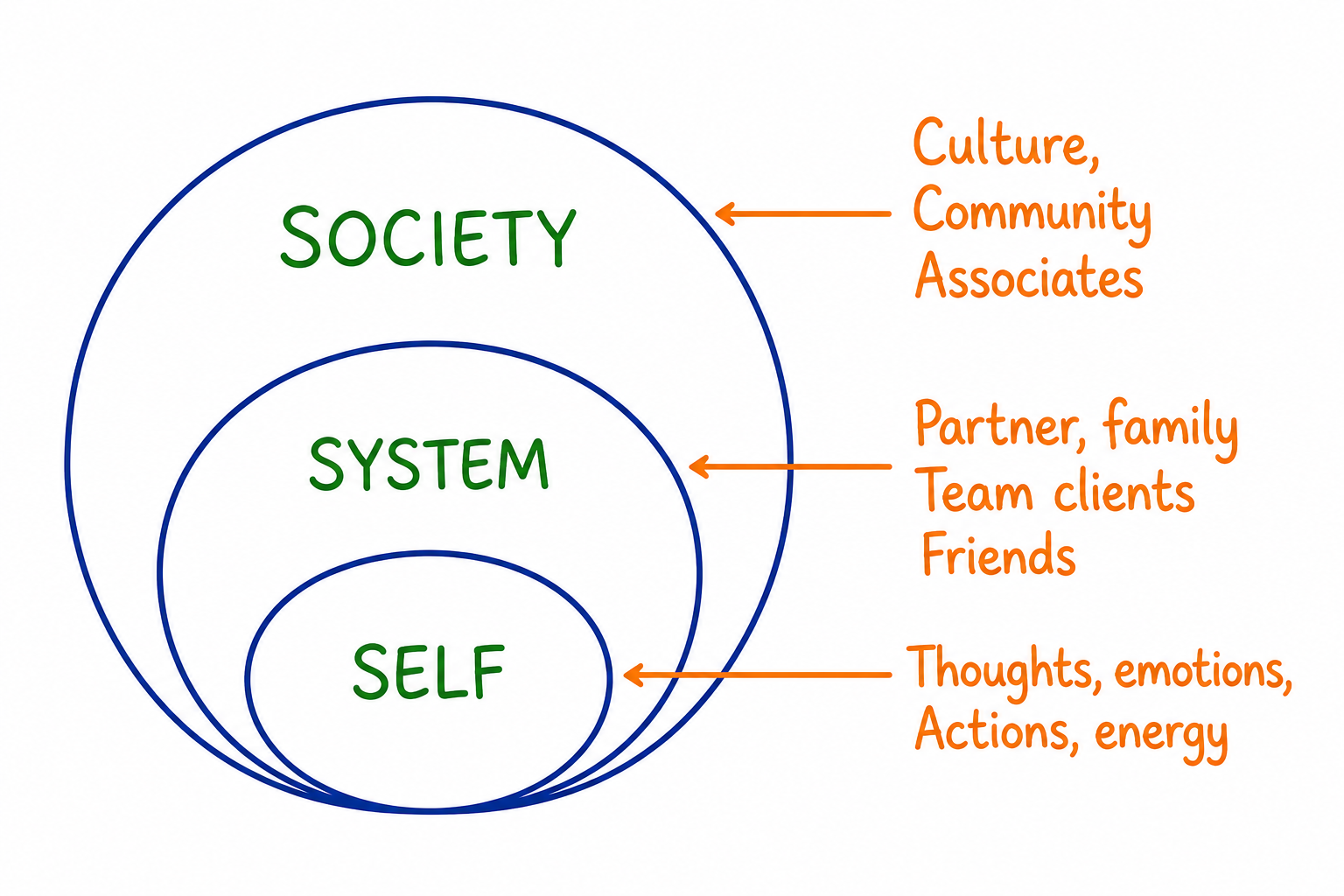
Like dropping a stone in water, the effect moves outward from wherever you are. You don’t have to say a word for it to travel.
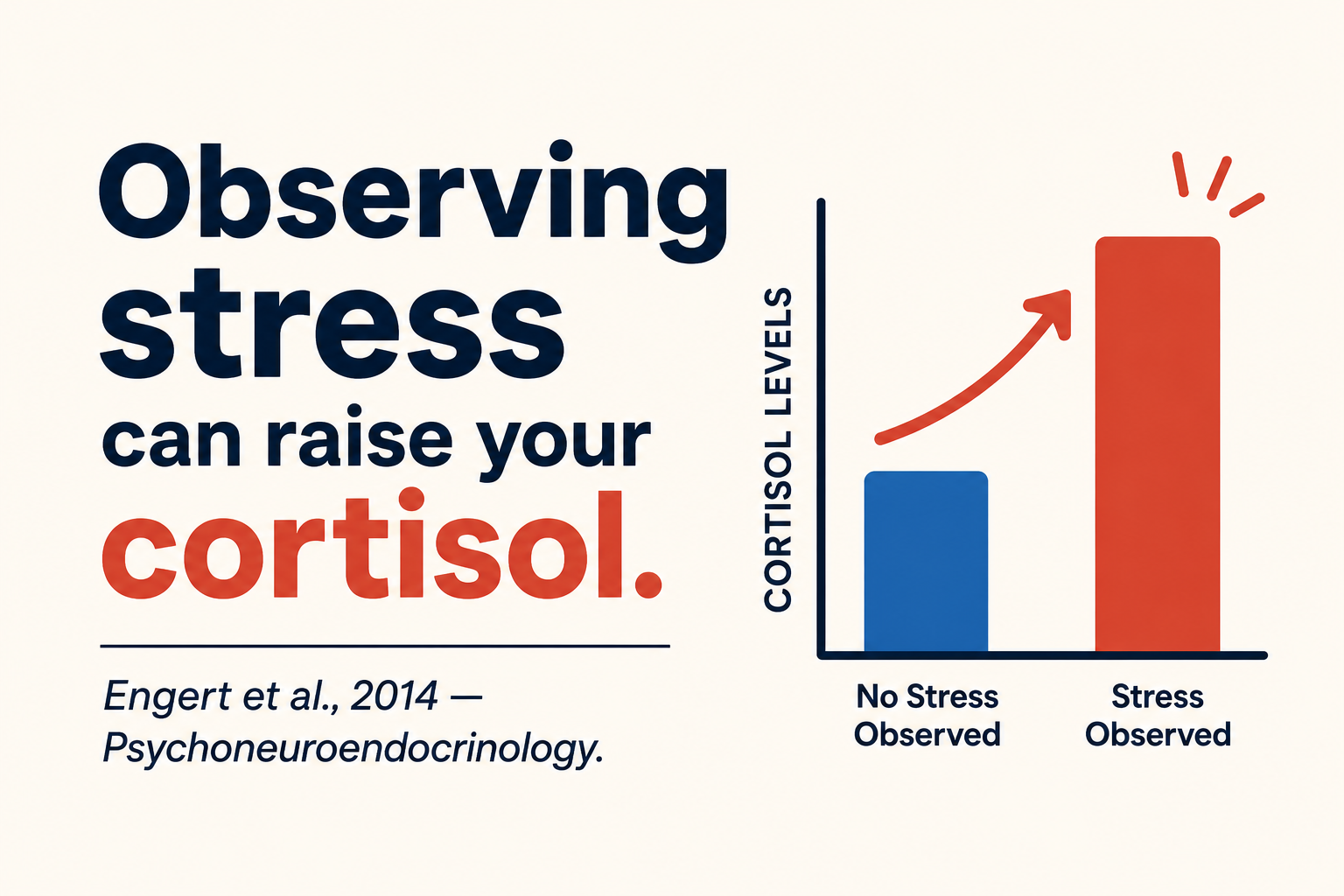
The research backs this up in a way most people don’t expect. A study published in Psychoneuroendocrinology found that simply observing someone under stress is enough to trigger a measurable increase in cortisol in the observer — a physiological stress response in a person who isn’t even in the stressful situation themselves. (Engert et al., 2014) Their body responds to your stress before their conscious mind has processed it.
Research by Repetti and Wang on job stress and family relationships confirms what many people privately suspect: chronic work stress follows people home, affects the quality of their presence, and creates lasting patterns in close relationships when it goes unaddressed over time.
The painful irony for people who care deeply is this: the harder you work to contain stress internally, the more it tends to escape indirectly. What doesn’t come out directly finds its way out anyway — through tone, through withdrawal, through reduced emotional warmth, through the atmosphere you create without meaning to.
What high functioning stress leakage actually looks like
High functioning stress leakage is what happens when someone is still performing externally, but their internal depletion has begun escaping through subtle channels — tone, energy, emotional availability, body language, and the quality of presence they bring to the people around them.
It doesn’t look like burnout from the outside. The person is still delivering. Still showing up. Still functioning. But internally the reservoir is low enough that the pressure starts escaping indirectly.
Think of it this way. When your energy is genuinely replenished, you’re grounded, warm, emotionally available, and able to handle pressure without it spilling into the people around you. When it’s depleted — not collapsed, just consistently low — you become less patient, more distant, more controlled, more flat. The version of yourself that shows up starts costing the people closest to you more than you realise.
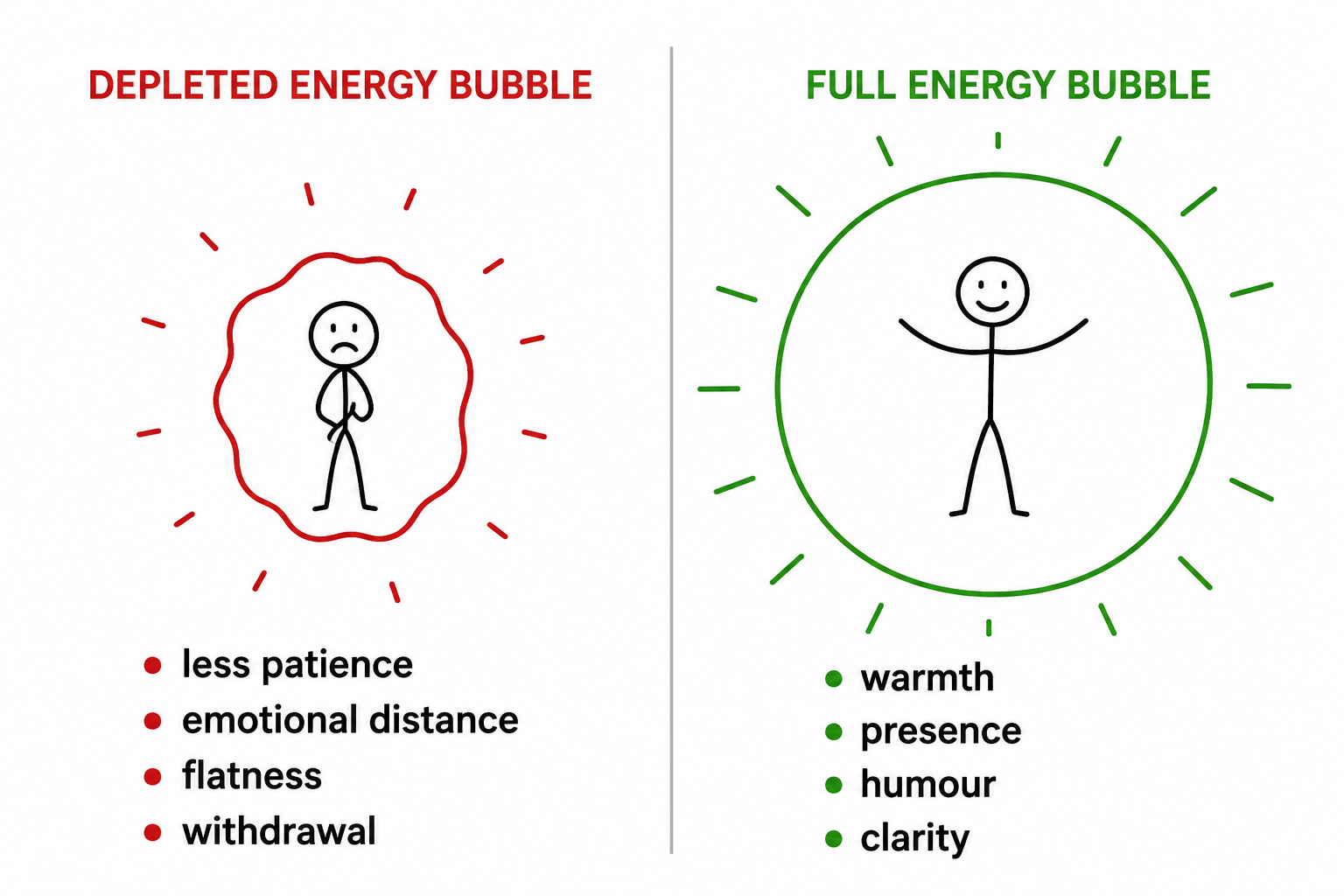
This tends to manifest in patterns that feel too small to address but compound over time. The short answer when your partner asks how you are. The distracted half listening your children feel even when they can’t name it. The team that stops bringing you problems because your energy signals that now isn’t a good time. The repeated apologies followed by the same behaviour because nothing at the root level has changed.
The people experiencing this aren’t causing it deliberately. They’re carrying real pressure and a genuine desire not to burden anyone. But intention doesn’t cancel effect. The stress is leaking — and the people around them are absorbing it — regardless of how much they care.
Why trying to hold it together can quietly make things worse
Here’s the part that surprises most people when they first hear it.
Trying harder to suppress internal pressure doesn’t stop it from affecting the people around you. In many cases it makes it worse. Because the energy required to contain stress — to stay composed on the surface while carrying significant internal load — is energy taken directly from the reservoir that would otherwise fuel emotional warmth, patience, genuine presence, and connection.
The cycle that forms is predictable once you can see it. You feel the pressure building. You work harder to contain it. You become less emotionally available as a result. The people closest to you feel the distance. The guilt increases. You redouble the effort to manage it internally. The pressure builds further.
This is compounded by the stress contagion research above. The people around you aren’t simply noticing your mood — their nervous systems are responding to the quality of your state. A person working hard to appear calm while internally dysregulated isn’t creating safety around them. They’re creating low level physiological activation in the people they most want to protect.
The Stress-Performance Pyramid helps explain why this keeps happening. Most people address stress at the Life Level — changing circumstances, managing time, adding recovery practices. These help. But when the Root Level is left untouched — the deeper behavioural patterns, the nervous system conditioning, the internal drivers that keep someone running on urgency even when they don’t need to — the pressure rebuilds faster than any surface level management can contain it.
Real containment isn’t about harder suppression. It’s about working at the level where the pressure is actually being generated.
How to stop your stress from leaking into relationships and work
This is where most people start with the wrong assumption.
They hear “protect your energy” and translate it as “do less and achieve less.” They assume that addressing the stress means reducing their ambitions or letting the people who depend on them down. That isn’t what’s required.
The goal isn’t to stop being highly responsible or ambitious. It’s to stop running it all on stress chemistry that’s quietly costing you and the people around you.
Some of the most effective early shifts are small and targeted rather than large and disruptive. A five minute pause before transitioning from work to home — not to perform presence, but to actually discharge some of the day before walking through the door. Naming what you’re carrying before entering a conversation instead of letting it leak indirectly into it. Putting your phone down fully for twenty intentional minutes rather than being half present for two hours. Scheduling genuine recovery with the same seriousness you schedule responsibility. Letting people support you instead of carrying everything alone.
None of these require dismantling your career. They require recognising that sustained performance without genuine recovery isn’t resilience. It’s depletion that hasn’t declared itself yet.
The highest performing people I’ve worked with aren’t the ones running hardest on pressure. They’re the people who know how to regulate, recover intentionally, communicate clearly, and create emotional safety for the people around them. Their ambition is intact. But the engine running it has changed.
And when that shift happens, something worth noticing becomes visible. Just as stress spreads physiologically, regulation spreads too. Calm is as contagious as pressure. When you stop leaking stress and start operating from a steadier place, the ripple effect that was quietly costing your relationships and your team can become the thing that sustains them instead.
Rest Won't Fix This Type of Burnout — Watch on YouTube
Frequently Asked Questions
Can my stress physically affect other people, not just their mood?
Yes. Research published in Psychoneuroendocrinology (Engert et al., 2014) found that observing someone under stress can trigger a measurable cortisol response in the observer — meaning people don’t just pick up on your mood emotionally, their bodies respond to it physiologically. This effect is strongest between people in close relationships, such as romantic partners and close colleagues.
What is high functioning stress leakage?
High functioning stress leakage describes what happens when someone is still performing well externally but their internal depletion has begun escaping through indirect channels — tone, energy, emotional availability, and the atmosphere they create for others. It doesn’t look like burnout from the outside, but the people closest to that person tend to feel it long before it becomes visible.
How do I know if my stress is already affecting my family or team?
Some common signs: your children ask you to listen more than once in a conversation. Your partner describes you as distant or distracted. Your team hesitates before bringing you problems. Small things trigger disproportionate frustration. You’re physically present in moments that matter but mentally somewhere else. If any of these feel familiar, the pressure is likely already leaking.
Why do I still feel depleted even after taking time off?
Time off addresses stress at the Life Level — the external circumstances. But if the Root Level patterns remain unchanged — the nervous system calibration, the behavioural loops, the deeper conditioning keeping you in urgency mode even when you stop — the depletion rebuilds quickly once you return. Rest matters. But rest alone can’t discharge pressure that wasn’t generated by overwork in the first place.
Is it possible to stop stress from spilling over without overhauling my whole life?
Yes. The most effective early shifts tend to be small and targeted — conscious transitions between work and home, naming what you’re carrying before conversations, building genuine recovery into the structure of your week rather than waiting until exhaustion forces it. The Stress-Less Scorecard below is a useful starting point for identifying where your pressure is actually building.
Stress that isn’t processed doesn’t disappear. It finds a way out — through tone, through withdrawal, through the quiet distance that grows between you and the people you care about most, through the atmosphere your team adapts to without naming it. The hidden cost of staying in high functioning containment mode for too long isn’t just personal. It’s relational. It moves through the people closest to you whether you intend it to or not.
The good news is that the same principle works in reverse. Genuine regulation spreads. Calm is as contagious as pressure. When you stop leaking stress and start leading from a steadier place, the people around you feel it — before you’ve said a single word about it.
Find out where your pressure is building — Take a Free Stress-Less Scorecard
If this has made you realise that your pressure may already be affecting your relationships, health, or work more than you’d thought, the free Stress-Less Scorecard is the clearest starting point. It’ll help you identify where pressure is building, what’s draining your capacity, and which deeper stress patterns may already be leaking into the areas of life that matter most to you. You’ll find it here.
About Charlotte Stebbing-Mills
Charlotte Stebbing-Mills is an award-winning wellbeing and performance expert with over 20 years of experience working with high performers, executives, and organisations across stress optimisation, burnout recovery, and sustainable high performance. She is the founder of The Wellness Theory and creator of the Stress-Performance Pyramid, the Well-Working Ecosystem, and the Ripple Effect Model.
Website: thewellnesstheory.com
Stress-Less Scorecard | Book an Exploration Call