
The 7 Identity Patterns Wiring You for Burnout
You've tried the breathwork, the cold plunges, the meditation app you downloaded, used for two weeks, then quietly abandoned along with the guilt of abandoning it. And still the same exhaustion returns right on schedule, as if your body was never actually convinced any of it worked. After twenty years working with high performing professionals through stress and burnout, I've come to believe the tools were rarely the real problem. The identity patterns that cause burnout aren't about which technique you're using. They're about a nervous system response you built decades ago, long before you had a career, a team, or a family depending on you, and that response is still running the show every time stress hits. This piece walks through the seven identity patterns most likely to be quietly driving your burnout, where they came from, and what it actually takes to change them.
Why do burnout patterns get wired into your nervous system before adulthood?
Burnout patterns get wired in early because your nervous system was built for survival, not performance. Long before you had language for what you were feeling, your body learned which responses kept you safe around the people who raised you, and it kept using them ever since.
This is what I mean by an identity pattern: a learned nervous system response tied to your sense of safety and worth, formed early and reinforced every time it worked. It isn't a personality trait and it isn't a flaw. It's a program your body built before you were old enough to choose it, and it still runs quietly underneath every deadline and every difficult conversation.
I grew up in a loving home, cared for by people doing their best. But there were turbulent stretches, moments when the air in the house felt tight enough to cut, and I learned two ways to cope. One was to stay alert, watch everyone's mood, and try to make things okay again. The other was to disappear under the covers until it passed. Neither was a decision I made consciously. Both got wired in, and both still show up decades later whenever stress arrives.
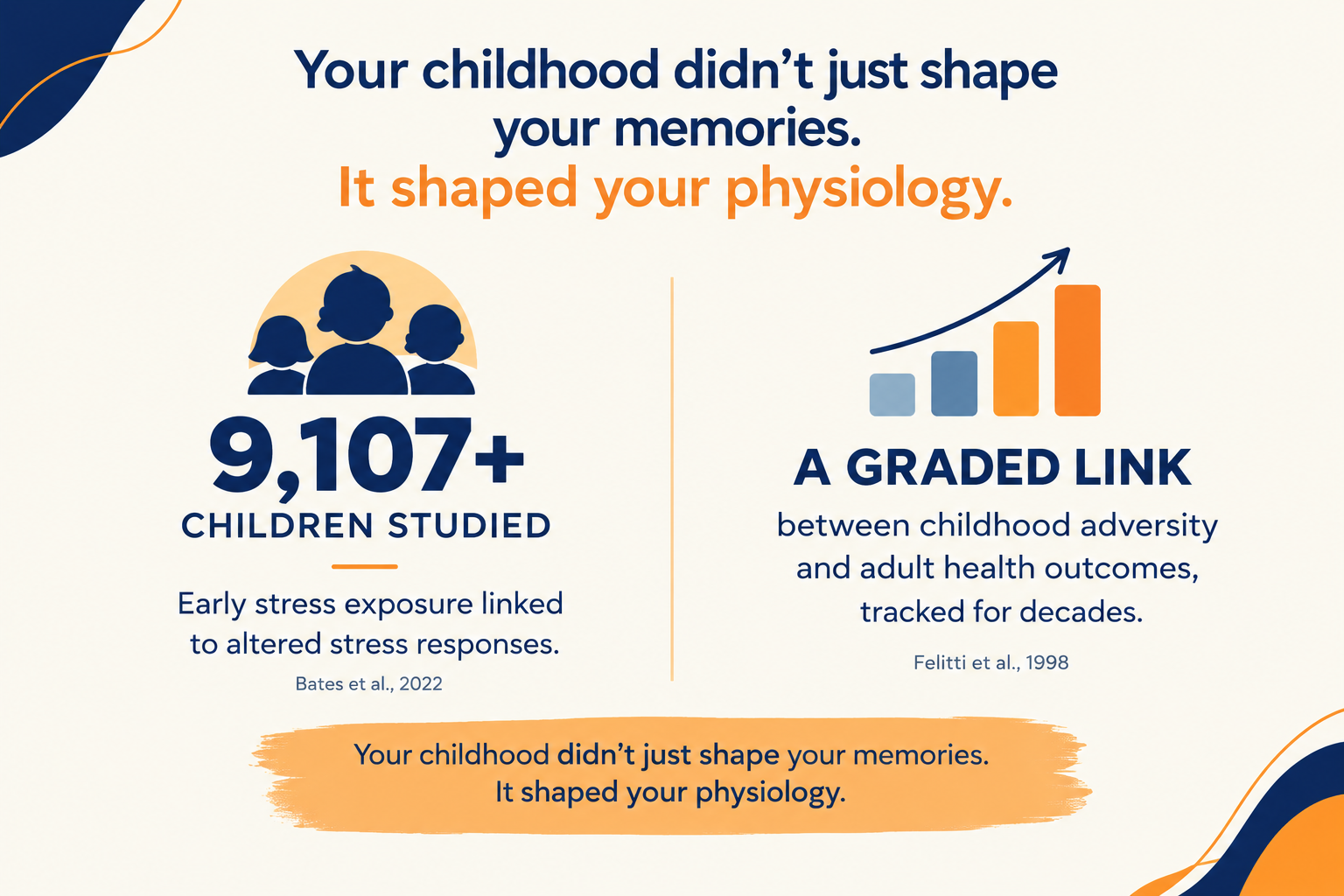
Research backs up what shows up in the coaching room. A 2022 review drawing on data from more than nine thousand children found that early stress exposure consistently altered children's physiological stress responses, especially when the caregiving relationship itself was the source of strain (Bates et al., 2022). Attachment researchers have similarly found that our earliest relationships calibrate how our stress physiology responds for years afterward (Pietromonaco & Powers, 2015). And the landmark Adverse Childhood Experiences Study found a graded relationship between the breadth of difficult exposures in childhood and adult health outcomes decades later (Felitti et al., 1998).
What are the 7 identity patterns that quietly drive burnout?
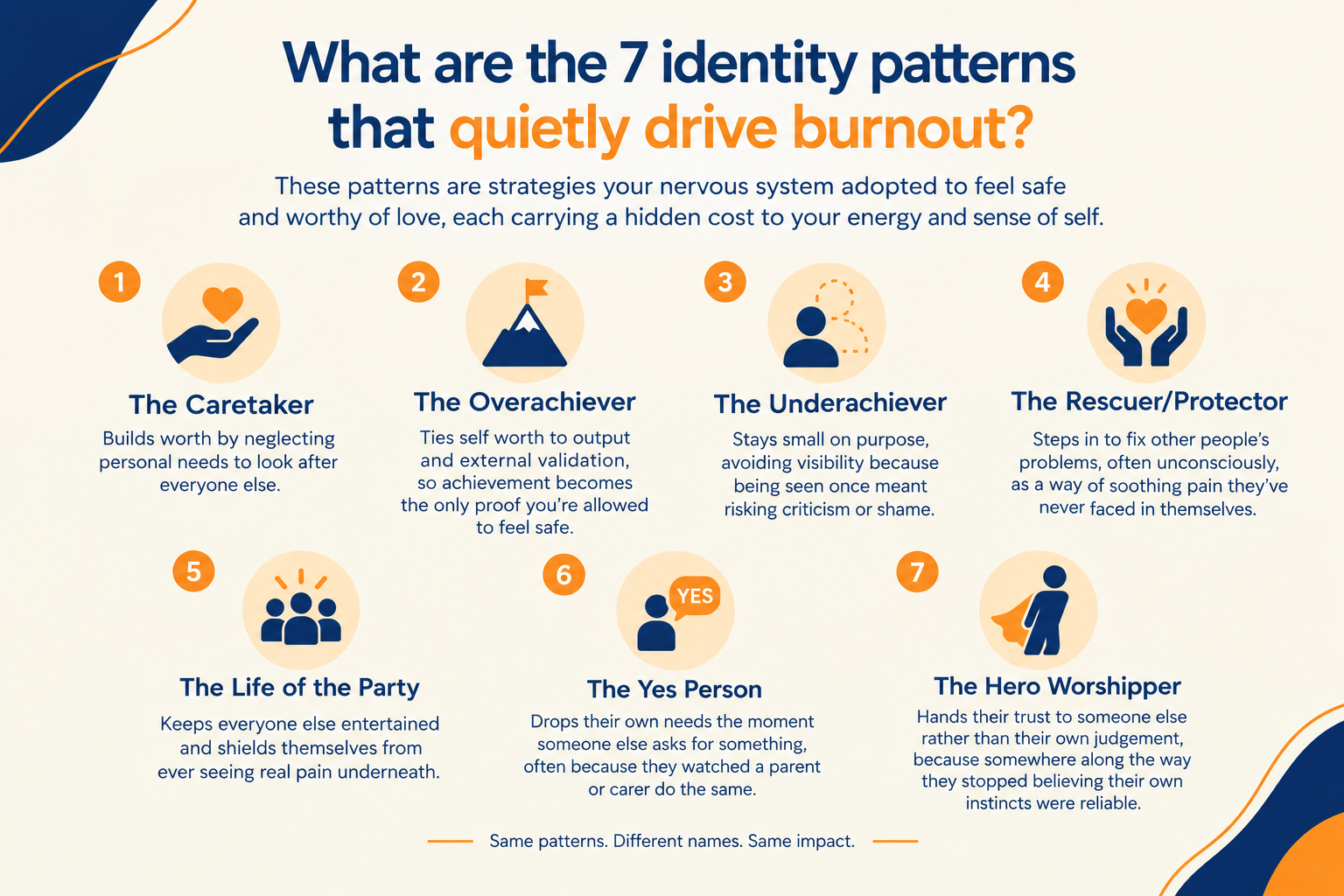
The seven identity patterns are strategies your nervous system adopted to feel safe and worthy of love, each carrying a hidden cost to your energy and sense of self. These patterns were first named by holistic psychologist Dr Nicole LePera, and I've combined them here with what I see repeatedly in the high responsibility clients I work with.
The Caretaker
Builds worth by neglecting personal needs to look after everyone else. I see this most clearly in parents whose children have grown and left, who no longer know how to enjoy their own life because they organised decades of it around someone else's needs.
The Overachiever
It is the pattern I see most often in my own client work. It ties self worth to output and external validation, so achievement becomes the only proof you're allowed to feel safe.
The Underachiever
It stays small on purpose, avoiding visibility because being seen once meant risking criticism or shame. From the outside it can look like procrastination, but underneath it's a nervous system that decided invisibility was safer than being fully seen.
The Rescuer or Protector
Steps in to fix other people's problems, often unconsciously, as a way of soothing pain they've never faced in themselves. It shows up constantly in the coaching and wellbeing world, where good intentions can tip into unqualified people trying to rescue others out of their own unresolved need to feel useful.
The Life of the Party
Keeps everyone else entertained and shields them from ever seeing real pain underneath. It creates a specific, quiet loneliness, because the version of you people love was never the whole truth.
The Yes Person
Drops their own needs the moment someone else asks for something, often because they watched a parent or carer do the same. Over time you lose track of what you actually want, because you've become fluent in everyone else's.
The Hero Worshipper
It hands their trust to someone else rather than their own judgement, because somewhere along the way they stopped believing their own instincts were reliable.
Why do coping patterns like people pleasing or overachieving feel impossible to stop?
These patterns feel impossible to stop because your nervous system reads them as safety, not as choice. Every time you say yes, rescue someone, or push for one more achievement, you get a small hit of relief, and your body quietly logs that pattern as proof of survival.
The trouble is that relief isn't the same as rest. Even after you've delivered, helped, or achieved, part of your system stays on alert, already scanning for the next chance to repeat the pattern and feel safe again. Live like that long enough and something gives: your opinions go quiet, your boundaries blur, and you keep functioning on a body permanently braced for the next demand.
None of these patterns are good or bad. They're coping mechanisms that once worked well enough to keep repeating. The problem isn't that you have them. It's that you've been trying to override a survival response with willpower alone, and willpower was never designed to out argue your nervous system.
What happens when you try to “do the opposite” of your pattern, and why that sometimes doesn't work?
Trying the opposite of your pattern, saying no when you'd normally say yes, or setting a limit when you'd normally overachieve, works for some people, and for others it reveals something more useful: it doesn't work at all. Noticing the pattern and deliberately doing its opposite is often enough to loosen its grip.
But if you genuinely try and can't follow through, that isn't a failure of discipline. It's information.
When the opposite feels impossible rather than just uncomfortable, it usually means the pattern is still doing a job your system hasn't found another way to do: keeping you safe and worthy of love in the only way it currently knows how. Pushing harder against a nervous system response rarely changes it. What changes it is addressing the belief underneath the behaviour: what you're afraid would happen if you stopped, and where you first learned that fear was necessary.
How do you build enough internal safety to actually change the pattern?
You build internal safety by working at the root of the pattern rather than the behaviour sitting on top of it. This is the Root Level of what I call the Stress-Performance Pyramid: underneath the visible pressures of your life, the Life Level, and the physical and emotional signals you're feeling, the Health Level, sits a deeper layer of identity, belief, and nervous system conditioning that's actually driving the whole thing.
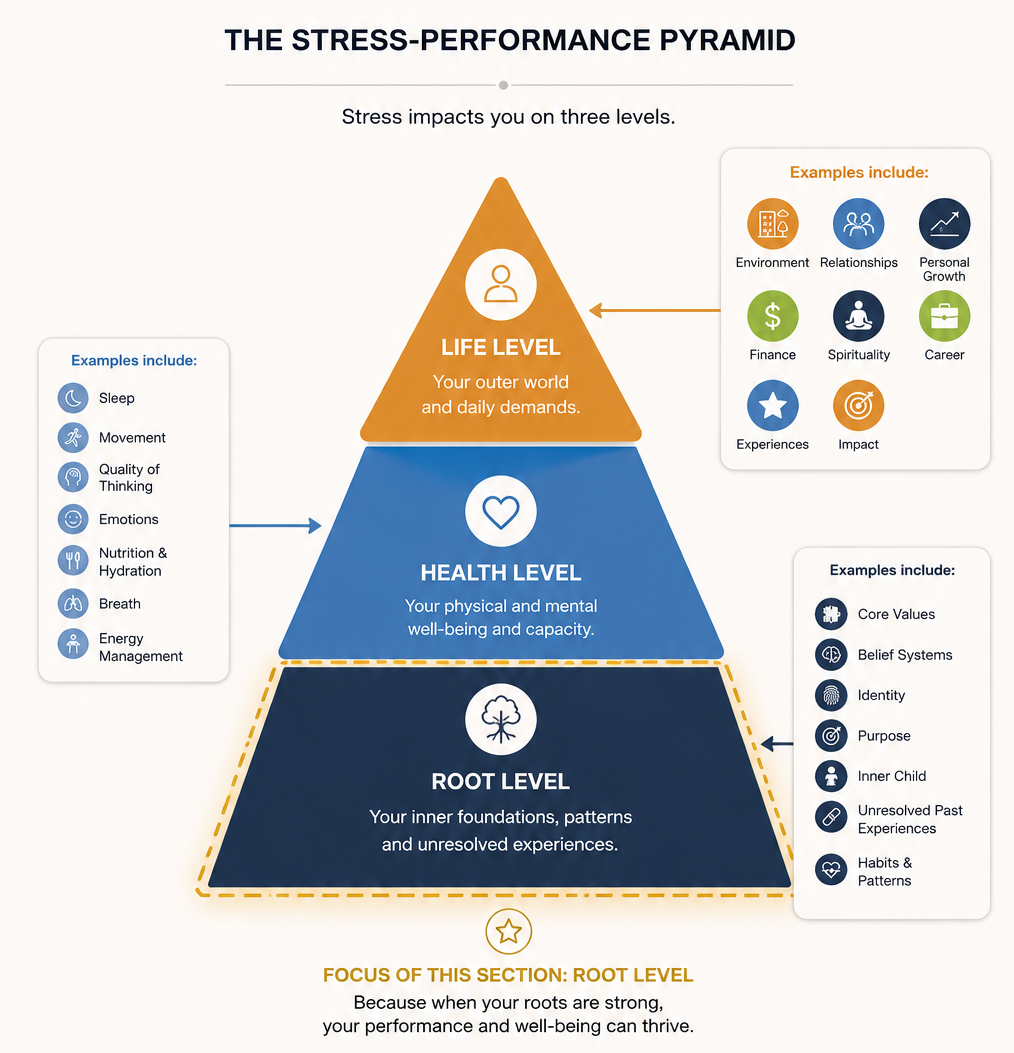
The high responsibility clients I work with usually arrive putting themselves last, reaching for a glass of wine or a hurried yoga class whenever the pressure spikes. The work that actually changes something happens when we address the belief behind why they feel they have to carry so much, which is the focus of. It was never really about carrying less. It's about changing your relationship to the load: carrying it from fear, bracing for everything to collapse the moment you stop, or carrying it from genuine safety, where slowing down doesn't feel like a threat to your worth.
Frequently Asked Questions
What are identity patterns and how do they cause burnout?
Identity patterns are the specific ways your nervous system learned to earn safety and love early in life: overachieving, people pleasing, staying invisible. They cause burnout because they keep your body in a low grade state of alert long after the original threat has passed, so you're spending energy maintaining an old survival strategy instead of genuinely resting. Over time that constant activation tips a capable person into exhaustion that rest alone doesn't fix.
Can burnout come from childhood conditioning rather than current stress?
Yes, and in my experience it usually does. Your current pressures, work, relationships, responsibility, are often the trigger, but the intensity of your response is shaped by patterns your nervous system learned decades earlier. That's why two people can carry the same workload and one burns out while the other doesn't. It's their conditioning that's different, not their willpower.
What is the Overachiever pattern and why is it the most common?
The Overachiever ties self worth to success and external validation, so achievement becomes the primary way of feeling seen, valued, and safe. It's the most common pattern I encounter because it's also the most rewarded: the professional world actively reinforces it with praise, promotion, and status, which makes it far harder to recognise as a stress response rather than a personality trait.
How do you break a pattern like people pleasing or overachieving?
Start by noticing the pattern in action and asking what you believe would happen if you didn't do it, then deliberately practise the opposite in low stakes moments. If that feels genuinely impossible rather than just uncomfortable, you need more internal safety first, built by addressing the belief and fear underneath the behaviour rather than forcing the behaviour to change on its own.
Are identity patterns permanent, or can they change?
They can change, because they were learned rather than fixed at birth, but they don't shift through insight alone. What changes them is building a genuine felt sense of safety in your body and your relationships, so the old pattern stops being the only route to feeling worthy of love, and naturally loosens rather than needing to be forced away.
What kept you safe as a child was never a mistake. It was the most intelligent response available given who was around you and what you needed to survive. The problem isn't that these patterns existed. It's that most of us never update them, so a strategy built for a five year old is still quietly running the show for the adult, the leader, and the parent you've become.
Take a Free Stress-Less Scorecard
If you recognise yourself in any of these patterns, the place I always suggest starting is the free Stress-Less Scorecard. It takes a few minutes and shows you exactly where your stress is sitting at the root level, not just on the surface. You'll walk away with a clearer picture of your own pattern than most people get from months of trying to work it out alone.
About Charlotte Stebbing-Mills
Charlotte Stebbing-Mills is an award-winning wellbeing and performance expert with over 20 years of experience working with high performers, executives, and organisations across stress optimisation, burnout recovery, and sustainable high performance. She is the founder of The Wellness Theory and creator of the Stress-Performance Pyramid, the Well-Working Ecosystem, and the Ripple Effect Model.
Website: thewellnesstheory.com
Stress-Less Scorecard | Book an Exploration Call