
What High-Functioning Burnout Actually Looks Like (Even When You're Still Performing)
You're still getting the work done. Still answering the emails, running the meetings, showing up for the people who need you. From the outside, nothing looks wrong. But you've noticed your patience has gotten shorter, your curiosity has gone quiet, and something you used to genuinely enjoy now just feels like one more obligation to get through. You've tried adjusting your morning routine, cutting back on caffeine, blocking out time to rest. None of it has touched what's actually happening, because these are the signs of high functioning burnout, and it doesn't show up as collapse. It shows up as a slow erosion inside someone who is still, technically, performing well. In twenty years of working with high achievers on stress and burnout recovery, I've learned that the people most at risk are rarely the ones who look like they're struggling. They're the ones holding everything together while something underneath them quietly gives way.
What is high-functioning burnout, and why does it hide inside your strengths?
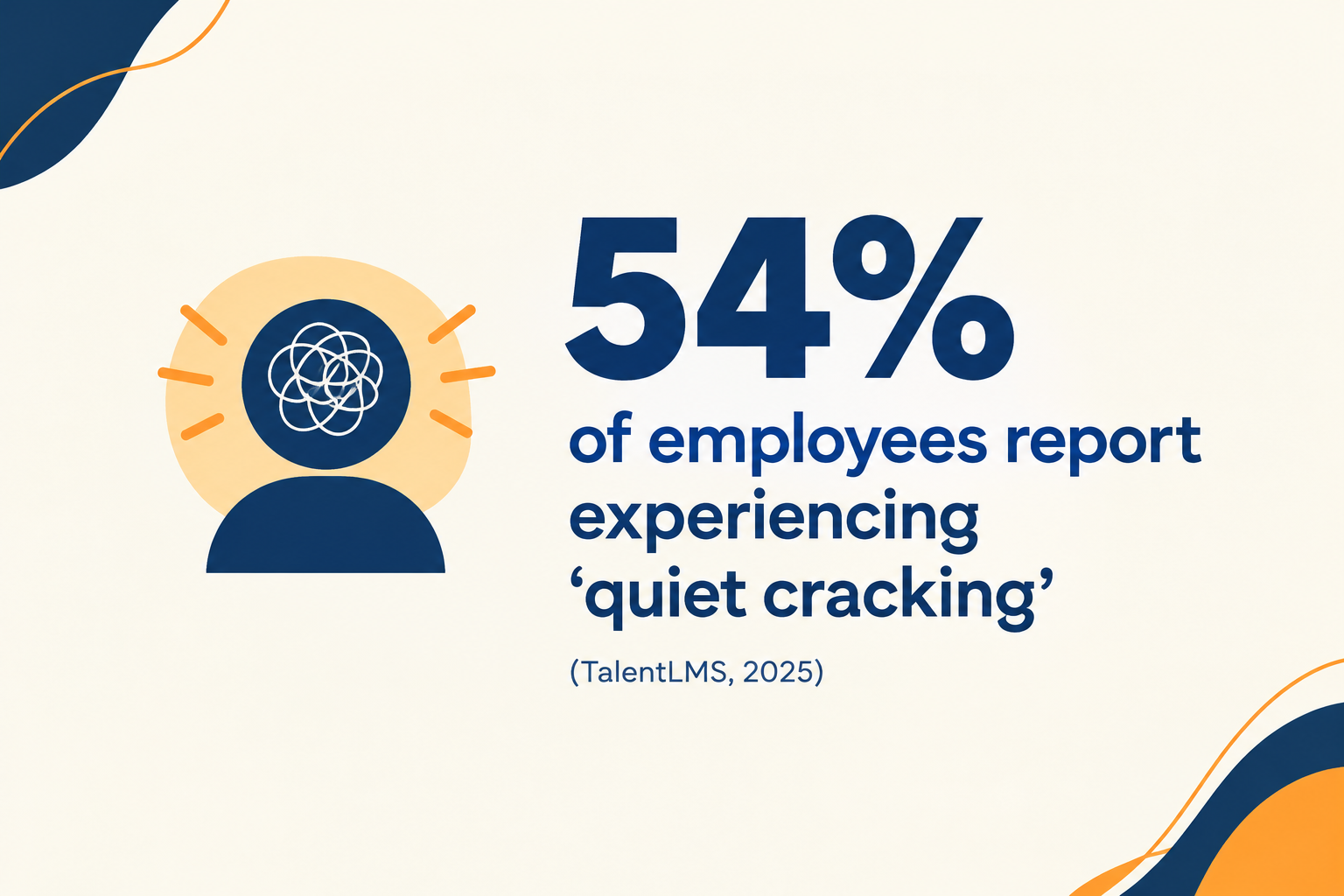
High functioning burnout is what happens when you keep performing at a high level while your internal capacity has already been used up. It's different from the version of burnout most people picture, because there's no dramatic collapse, no visible signal, and often no interruption to output at all. Researchers have recently given this a name: quiet cracking. It describes continuing to meet your responsibilities while experiencing increasing strain underneath the surface, and new workplace research from TalentLMS found that 54 percent of employees report experiencing some degree of it.
What are the signs of high-functioning burnout most people miss?
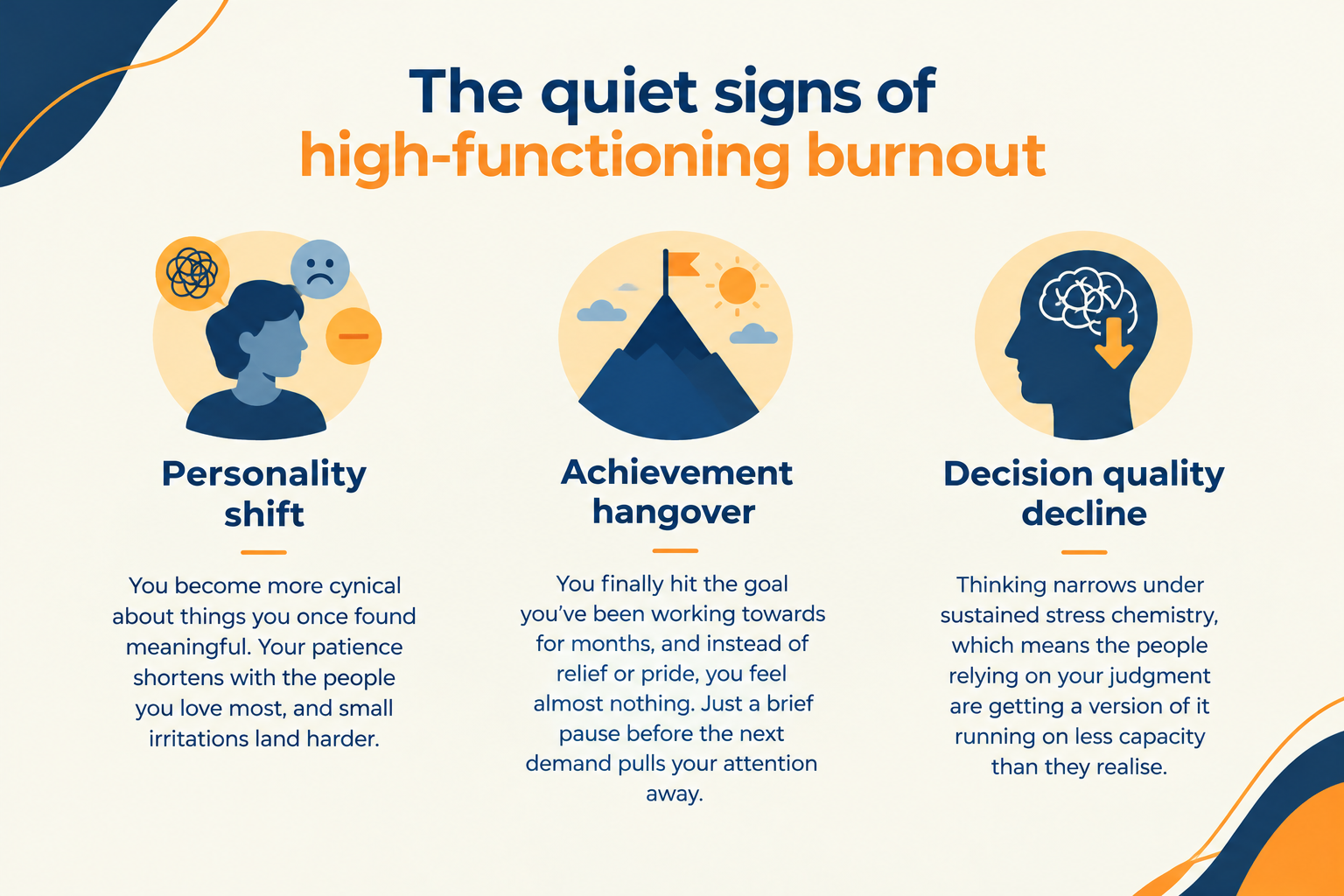
The clearest signs of high functioning burnout aren't exhaustion itself. They're the quiet personality shifts that happen around it. You become more cynical about things you once found meaningful. Your patience shortens with the people you love most, not the people who challenge you professionally. Small irritations land harder than they should, and moments that used to bring satisfaction start to feel flat.
One of the clearest markers I see in clients is what I call the achievement hangover: you finally hit the goal you've been working towards for months, and instead of relief or pride, you feel almost nothing. Just a brief pause before the next demand pulls your attention away. Alongside this, decision quality quietly declines. Thinking narrows under sustained stress chemistry, which means the people relying on your judgment are getting a version of it running on less capacity than they realise. None of this looks like crisis. It looks like a slightly duller version of someone who is still, by every visible measure, doing fine.
Why does “quiet cracking” happen even when you love your work?
Quiet cracking happens because the exhaustion isn't coming from disliking the work. It's coming from caring about it more than your current capacity can sustain. Most of the high achievers I work with aren't depleted because they resent their responsibilities. They're depleted because there's a gap between what matters to them and what they currently have the bandwidth for, and that gap creates a kind of moral pressure that keeps them going long after their nervous system has asked them to stop.
This is compounded by an isolation that high responsibility people rarely name. Parents don't tell their children how stretched they feel. Leaders don't tell their teams. Founders are often too invested in the mission to admit the cost it's extracting from them. The result is someone surrounded by people who depend on them, while feeling completely unsupported themselves. Caring this much was never the problem. Carrying it without acknowledgment, recovery, or support is.
What is low-grade activation, and why is it wearing you down?
Low grade activation is the state of being mildly switched on almost constantly, even when nothing urgent is actually happening. Think of a car engine left running all day. It's never accelerating, never in obvious distress, but it's still burning fuel and wearing down every hour it idles. Most of us aren't living through a daily crisis. We're living inside a version of this idle state: checking messages before we're out of bed, carrying work conversations in our pockets everywhere we go, scrolling even during the moments meant for rest.
Stress physiologists describe the cumulative cost of this as allostatic load, which research published in the New England Journal of Medicine defines as the price the body pays for staying activated long after the original demand has passed. What makes this genuinely difficult is that the behaviours keeping the engine running are the same ones our environments reward. Instant responsiveness gets praised as commitment. Never dropping a task gets read as reliability. But sometimes these are simply signs the system has been running without a real off switch for far too long. Eventually the tank isn't empty enough to force you to stop, but it's no longer full enough for you to actually thrive. That's the exact space where high functioning burnout lives.
What actually helps: removing load before adding more solutions
What actually helps first isn't another routine. It's removing something before you add anything. Most high achievers, when they notice they're struggling, reach for more: another supplement, another morning ritual, another productivity hack. But an already depleted system doesn't need more input. It needs less load, done better.
It's also worth naming plainly: burnout isn't only a personal pattern. It's often structural too, poor workload design, poor recovery culture, workplaces that reward the exact behaviours quietly cracking you. Working only on yourself as an individual will only ever solve half the equation.
Start with one honest question: what is this actually costing you? Then get specific about where your energy is leaking. Is it the belief that rest has to be earned? Is it a boundary that no longer exists? One client I worked with introduced a single rule: no phone between 7pm and 7am. She realised her phone had been connecting her to other people's needs for sixteen hours a day. Within a few weeks of that one boundary, her sleep, her patience, and her mental clarity all began to return. One change. That's often where recovery actually starts, not in a bigger overhaul, but in identifying and removing the one thing quietly draining you the most.
Frequently Asked Questions
What is high-functioning burnout?
High functioning burnout is a state where someone continues to perform, deliver, and meet responsibilities at a high level while running on significantly depleted internal capacity. It doesn't show up as collapse or absence. It shows up as reduced patience, quiet cynicism, flat emotional responses, and a growing gap between how someone appears and how they actually feel.
What is “quiet cracking” and how common is it?
Quiet cracking is the term researchers now use to describe employees who continue meeting their responsibilities while experiencing increasing strain beneath the surface. Recent workplace research from TalentLMS found that 54 percent of employees report experiencing some degree of it, which suggests this is closer to a norm inside modern workplaces than an exception.
Can you be burned out while still performing well?
Yes, and this is exactly what makes high functioning burnout so easy to miss. Performance is often one of the last things to decline, because high achievers draw on identity, habit, and sheer discipline to keep output steady long after their internal resources are gone. The cost shows up first in patience, presence, and decision quality, not in the work itself.
Is this caused by personal habits or workplace structure?
Both, and treating it as purely personal misses half the picture. Individual patterns like believing rest has to be earned or an inability to say no absolutely play a role. But workload design, recovery culture, and boundaries set at an organisational level are just as responsible, which is why working only on yourself will only ever get you partway there.
What's one small change that helps recovery start?
Removing something is usually more effective than adding something. Rather than introducing a new routine, identify one specific source of ongoing drain, a boundary that's missing, an obligation that isn't actually yours, and remove or adjust it directly. One client's entire recovery began with a single rule: no phone between 7pm and 7am.
High functioning burnout doesn't ask you to stop caring, stop being capable, or become someone smaller. It asks you to notice where responsibility has quietly turned into neglecting yourself, and to give your nervous system the recovery it's been asking for the whole time you were too busy delivering to hear it.
Take a Free Stress-Less Scorecard
If any of this is landing, the most useful next step isn't another framework to apply on top of everything you're already carrying. It's understanding exactly where your own stress is showing up right now. The free Stress-Less Scorecard maps your stress across three levels, your life, your health, and the deeper root drivers most people never get shown how to look at. It takes about five minutes, and for most people, it's the first time they can see clearly which level has been missing from everything they've already tried.
About Charlotte Stebbing-Mills
Charlotte Stebbing-Mills is an award-winning wellbeing and performance expert with over 20 years of experience working with high performers, executives, and organisations across stress optimisation, burnout recovery, and sustainable high performance. She is the founder of The Wellness Theory and creator of the Stress-Performance Pyramid, the Well-Working Ecosystem, and the Ripple Effect Model.
Website: thewellnesstheory.com
Stress-Less Scorecard | Book an Exploration Call