
Why High Performers Secretly Feel Drained
You had a genuinely productive day. Deadlines met, decisions made, people handled well. And at eleven that night you're still lying there with your mind running, not panicking, just on, scanning for whatever's next before you've properly landed from what just happened. If you're asking why do high performers feel drained even when everything on paper says they're doing brilliantly, here's the honest answer. It isn't that you're carrying more stress than anyone else. It's that your system never gets to finish coming back down before the next demand arrives. In nearly two decades working in stress physiology and performance, I've coached hundreds of high capacity leaders who can execute beautifully under pressure and still feel exactly this: composed outside, quietly eroding underneath. This isn't a stamina problem. It's a recovery problem. And once you can see the mechanism driving it, you can actually change it.
Why Missing Recovery is The Problem, Not Stress Itself
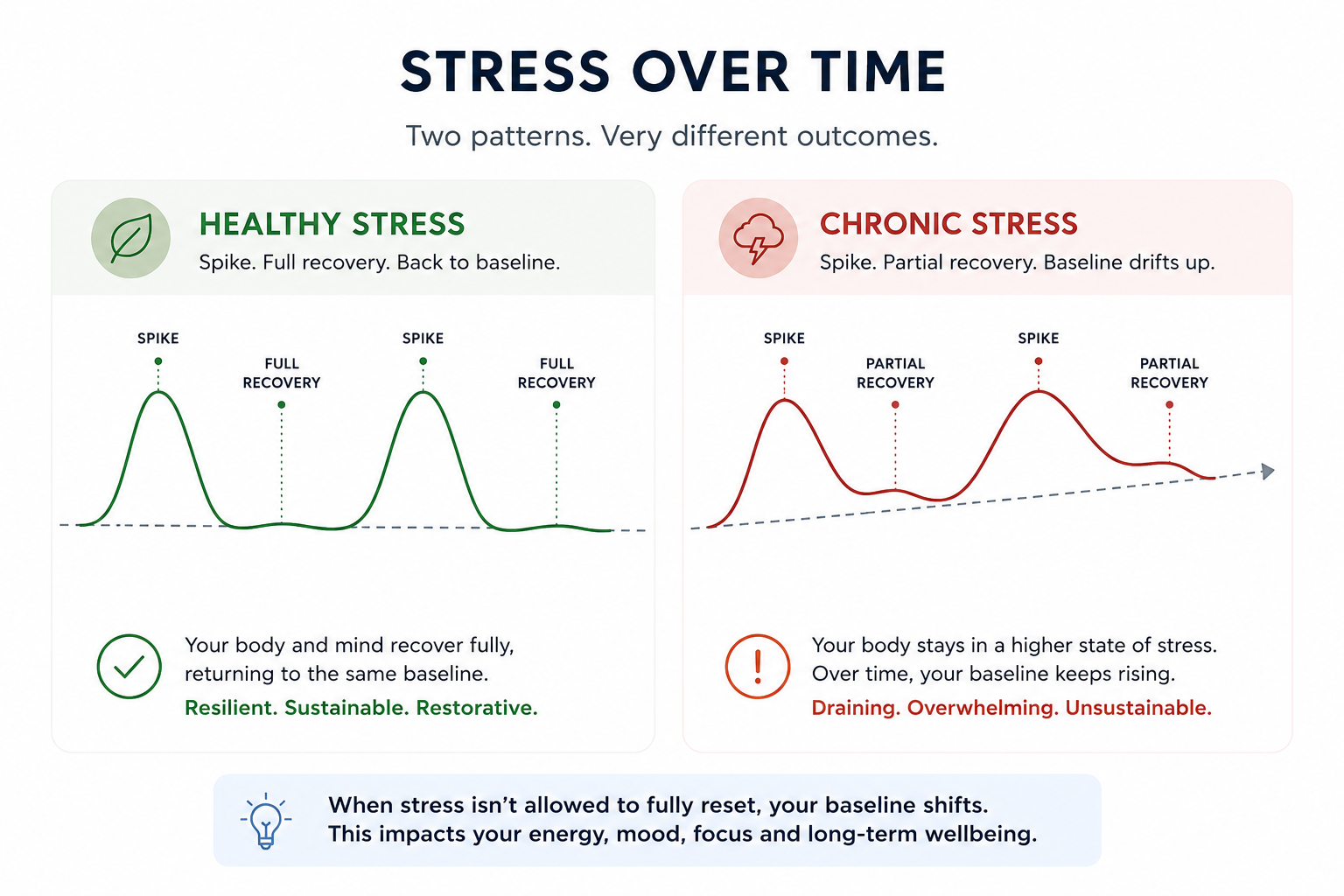
Missing recovery is the problem because stress was never designed to be a steady state. It's built to spike, then fully resolve, then adapt you to handle a little more next time. That's the entire mechanism behind healthy stress: spike, recover, adapt, grow. What I see in almost every high capacity leader I work with isn't too much stress. It's a system that spikes again before the last spike has actually resolved, so recovery only ever gets partial, and the baseline quietly creeps upward each time.
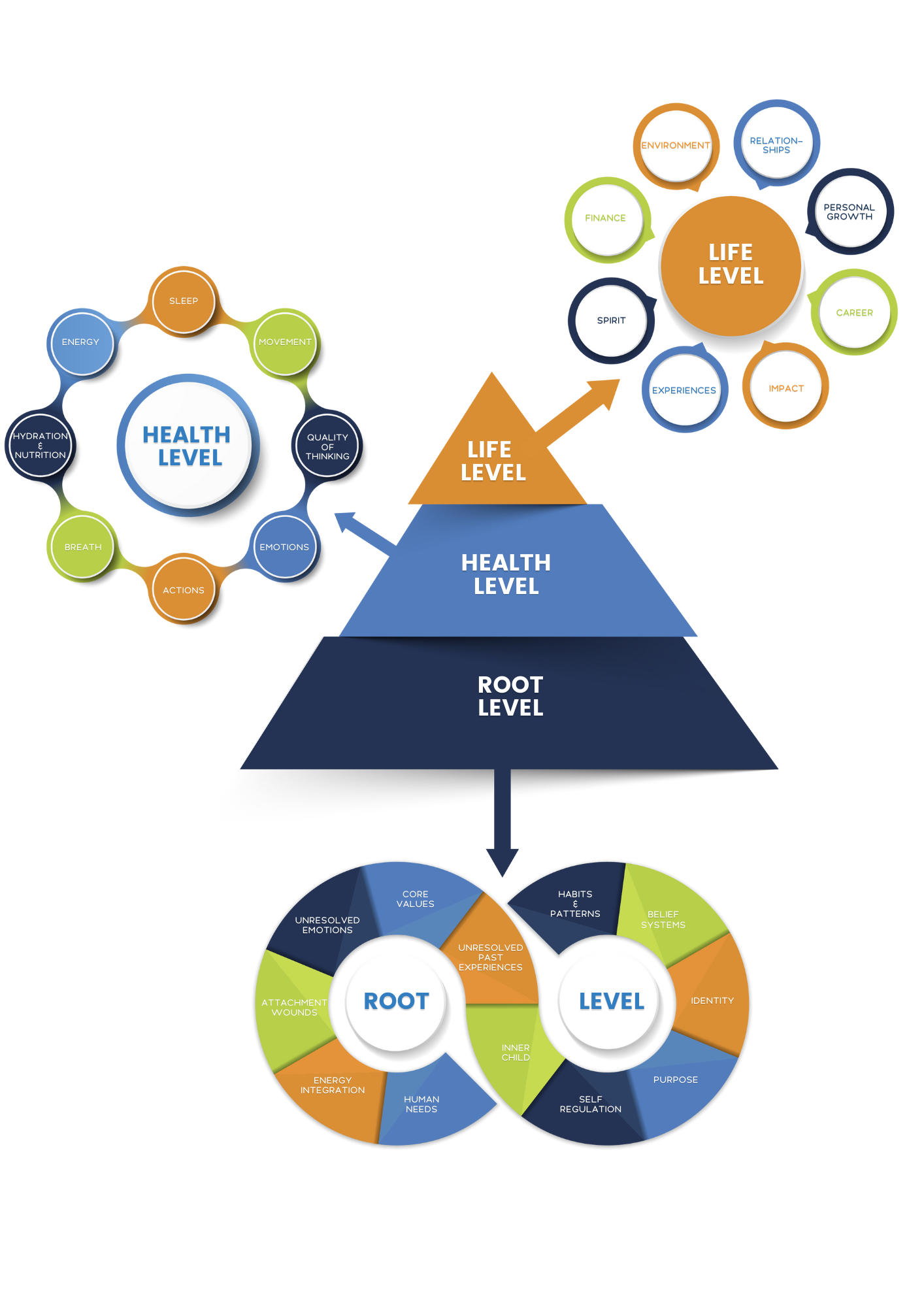
This is what I map with clients as the Health Level inside the Stress Performance Pyramid, one of three layers where stress shows up, alongside the Life Level, the external circumstances and deadlines you could point to on a calendar, and the Root Level, the identity and behavioural patterns sitting underneath both. At the Health Level, the pattern that actually predicts exhaustion isn't the size of any single spike. It's whether the system gets back to baseline before the next one lands. Healthy stress looks like a wave returning to flat water. Chronic stress looks like a wave that never quite settles before the next one arrives, so the water line itself keeps rising.
Research on allostatic load, the physiological cost of exactly this pattern, backs this up directly. Chronic stress accumulates wear across the body specifically when the stress response activates again before it's had time to deactivate properly (McEwen, 2004). You don't feel drained because you can't handle pressure. You feel drained because you haven't fully recovered from the last round of it, and the next one is already loading.
Why Overdrive Feels Identical To Ambition
Overdrive feels identical to ambition because both produce the exact same sensation in the moment, sharp, alert, slightly urgent, like you're operating right at your edge. The difference isn't how it feels while you're in it. It's what happens the second the demand stops. Ambition allows your system to properly stand down once the work is done. Overdrive keeps it standing to attention long after there's nothing left to respond to.
I know this pattern intimately. There was a period where I was delivering at a high level, speaking, coaching, building, and by every external measure things looked strong. But at night I couldn't switch off. My body stayed braced, still anticipating, still on. I told myself that was simply what ambition felt like, and I was almost proud of it, until my sleep started fragmenting, my patience shortened, and my thinking lost its usual clarity.
Think of it like a light switch. In healthy stress, it flips on when you need it, then flips fully off again once the task is done. In high functioning chronic stress, it never fully switches off. It dims, flickers, and stays faintly lit in the background, quietly using energy you think you've already spent. That faint, constant hum is activation without oscillation, and activation that never oscillates back down reduces your capacity over time, no matter how driven or capable you are.
Why Rest Isn't The Same As Recovery
Rest isn't the same as recovery because rest is the absence of activity, while recovery is your nervous system actually returning to baseline. You can be entirely inactive and still be activated. You can lie on a beach and still feel your jaw tight and your mind circling. You can breathe deeply for ten minutes and snap at someone five minutes later, because the breath changed your state temporarily without ever completing the reset underneath it.
This is the definition worth sitting with. Recovery isn't the absence of work. It's the return to baseline, the point where your system stops scanning, stops planning, stops bracing, and settles. If your body doesn't know how to downshift fully, rest stays surface level no matter how long you take or how far you travel to get it. Research on psychological detachment from work backs this up specifically. It isn't the leisure activity itself that predicts wellbeing, it's whether a person genuinely disengages from work related thoughts during that time, and that disengagement is what actually differentiates recovery from mere time off (Sonnentag and Fritz, 2007).
Real recovery happens when your nervous system completes the stress cycle rather than freezing partway through it. That means recognising activation early and returning to recovery sooner, instead of letting spikes compound on top of each other. Your heart rate rising and your thinking speeding up under pressure is completely normal. The skill isn't avoiding that. It's coming back down afterwards, sooner rather than later.
What Full Nervous System Reset Actually Feels Like
A full nervous system reset feels quiet in a way that can be almost unfamiliar if you've been running elevated for years. You're not scanning for the next problem. You're not mentally rehearsing tomorrow. You're not bracing for something to go wrong. You're simply settled, and that settled state is what baseline restoration actually feels like, not relaxed in a fragile, temporary way, but genuinely reset.
This takes longer than most people expect, which is exactly why a single weekend rarely delivers it. Studies measuring heart rate variability after a demanding mental task have found that some markers of stress recovery return to normal almost immediately, while a slower recovery component can take up to two hours to fully settle after just one stressful episode (Usui and Nishida, 2017). Multiply that across a day full of back to back demands, and it's easy to see why a system under sustained pressure rarely gets the runway it needs to actually complete the reset, even when the person looks and functions completely fine on the surface.
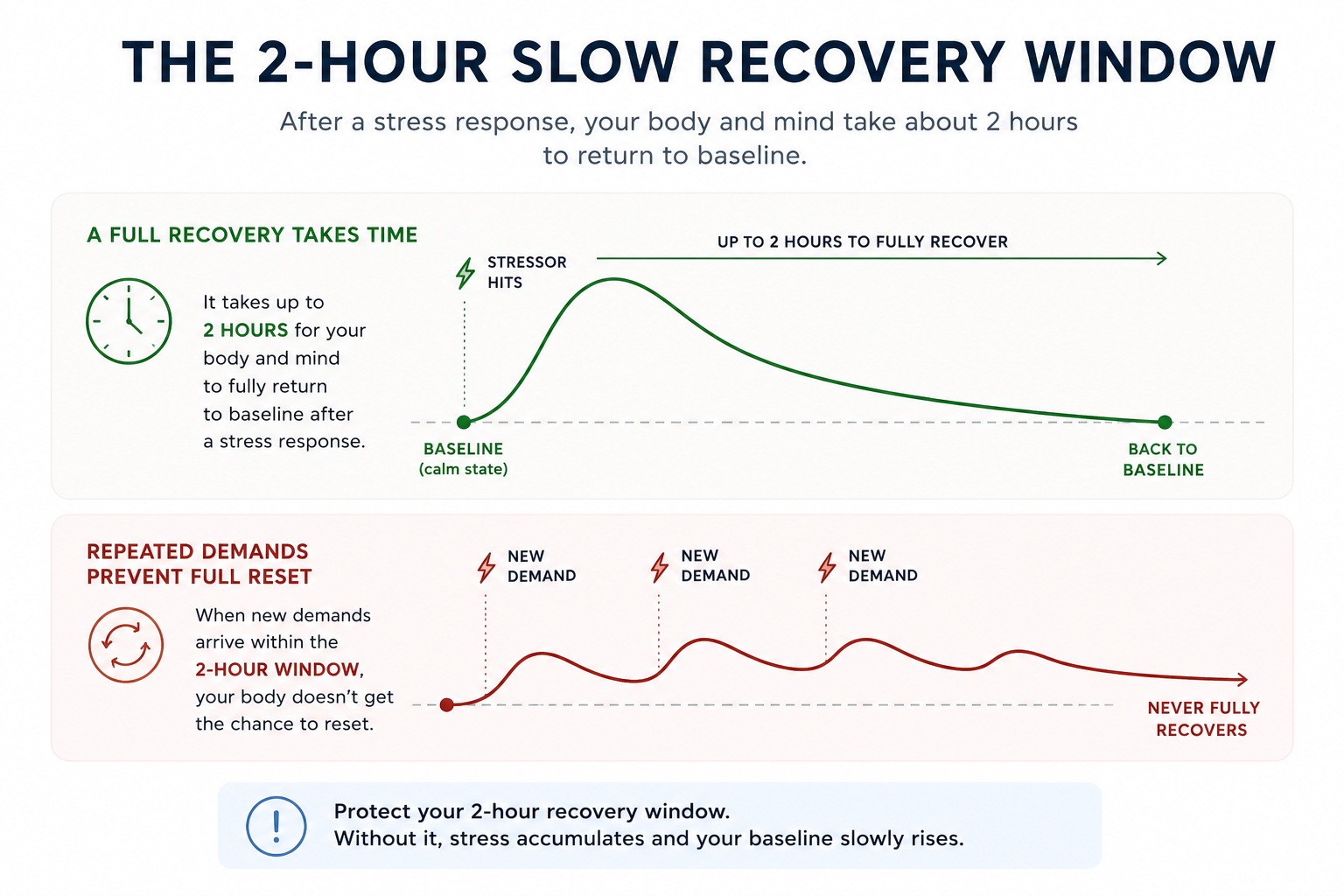
Performance rises when every spike is followed by full recovery. That's adaptation, and it's what makes resilience compound over time instead of quietly draining away. Performance falls when recovery never completes, and that incomplete cycle is exactly where secretly drained lives, underneath a schedule that still looks impressive from the outside.
Frequently Asked Questions
How can I tell if I'm in chronic activation rather than just busy?
Busy resolves once the task ends. Chronic activation doesn't. If you notice you're still scanning, still mentally rehearsing tomorrow, or still physically tense an hour after the demand has passed, that's activation persisting past the point where it should have switched off. Other markers include sleep that doesn't feel restorative even when it's long enough, and irritability that surprises you because it feels disproportionate to whatever just happened.
Why do holidays stop feeling restful for high performers?
Because a nervous system that's used to staying elevated doesn't downshift just because the calendar's clear. Genuine recovery needs psychological detachment, not just physical distance from work, and if your mind is still checking, planning, or anticipating from the beach, the holiday is providing rest without providing recovery. That's why the first few days away often still feel anxious before anything actually settles, if it settles at all.
What does oscillation actually mean for performance?
Oscillation means a spike followed by a genuine return to baseline, repeated over time. It's this rhythm, not the peaks alone, that builds capacity, because the trough is where adaptation actually happens. Sustained high activation without troughs doesn't build resilience. It erodes it, because the system never gets the recovery window it needs to consolidate the gains from the effort you just put in.
Is overdrive always harmful, or is some of it normal?
Short bursts of overdrive are completely normal and sometimes necessary. Intensity itself was never the problem. The harm comes from sustained overdrive with no recovery window built in, where one spike stacks on the next until the baseline itself has shifted upward. Ambition paired with genuine oscillation is sustainable. Ambition with no oscillation at all is what quietly turns into erosion.
Can you be high functioning and still be running on empty?
Yes, and this is precisely what high functioning burnout looks like. The person keeps delivering, keeps meeting expectations, and keeps looking composed, while internally the reserves keep dropping. It's different from the more visible, collapse style burnout most people picture, which is exactly why it goes unnoticed for so long, including by the person experiencing it.
Take a Free Stress-Less Scorecard
If you want to know whether your own system is still running on survival rather than safety, the free Stress Less Scorecard is the fastest way to see it clearly. It takes less than three minutes, and it will show you whether you’re still fixing burnout the old way, focused on workload and willpower, or actually addressing the pattern underneath it. You’ll walk away with a clear picture of where your stress is really coming from and what would genuinely change it.
About Charlotte Stebbing-Mills
Charlotte Stebbing-Mills is an award-winning wellbeing and performance expert with over 20 years of experience working with high performers, executives, and organisations across stress optimisation, burnout recovery, and sustainable high performance. She is the founder of The Wellness Theory and creator of the Stress-Performance Pyramid, the Well-Working Ecosystem, and the Ripple Effect Model.
Website: thewellnesstheory.com
Stress-Less Scorecard | Book an Exploration Call