
Why Lifestyle Changes Alone Won't Fix Identity-Driven Burnout
You've fixed your sleep. You've set boundaries. You've cut the caffeine and blocked out the calendar the way every article told you to. And you still wake up feeling like you're wearing a costume of yourself. That's what nobody explains about high-functioning burnout: sometimes every habit change works exactly as intended, and the exhaustion doesn't move an inch. I've worked with high performers, founders, and leaders for over twenty years, and the pattern underneath this usually isn't a lifestyle problem at all. It's identity-driven burnout, exhaustion that comes not from what you're doing but from who you've had to become in order to keep doing it. Lifestyle changes matter, but if the version of you making them is the same version that burned out in the first place, they won't hold. This article explains what identity-driven burnout actually is, why the advice to simply slow down often makes it worse, and what needs to happen before any habit change will stick.
What is identity-driven burnout, and how is it different from workload burnout?
Identity-driven burnout is exhaustion that comes from sustaining a version of yourself built through pressure, responsibility, or expectation, rather than from the sheer volume of work. It's different from workload burnout, where exhaustion tracks fairly directly with hours or capacity, and tends to ease once the workload does.
With identity-driven burnout, you can reduce the hours, delegate the tasks, and take the holiday, and the flatness doesn't shift, because the exhaustion was never really about the tasks. It was about maintaining a role or a standard you built while becoming successful, one that never got questioned once it stopped fitting who you are today. I see this constantly in founders and executives who look, by every visible measure, like they're thriving. The business is growing. The title is impressive. And underneath it, they can't remember the last time they felt like themselves rather than a very competent performance of themselves.
This is the distinction most burnout advice misses. Workload burnout responds to rest. Identity-driven burnout doesn't, because rest never touches the actual driver: a self built for survival rather than chosen on purpose. Research on high pressure occupations backs this up: a clearer, more stable sense of self is linked to lower burnout and stronger resilience under sustained demand (Wu, Liu, Li, Yu, Liu, & Tian, 2024).
Why does slowing down make anxiety worse instead of better?
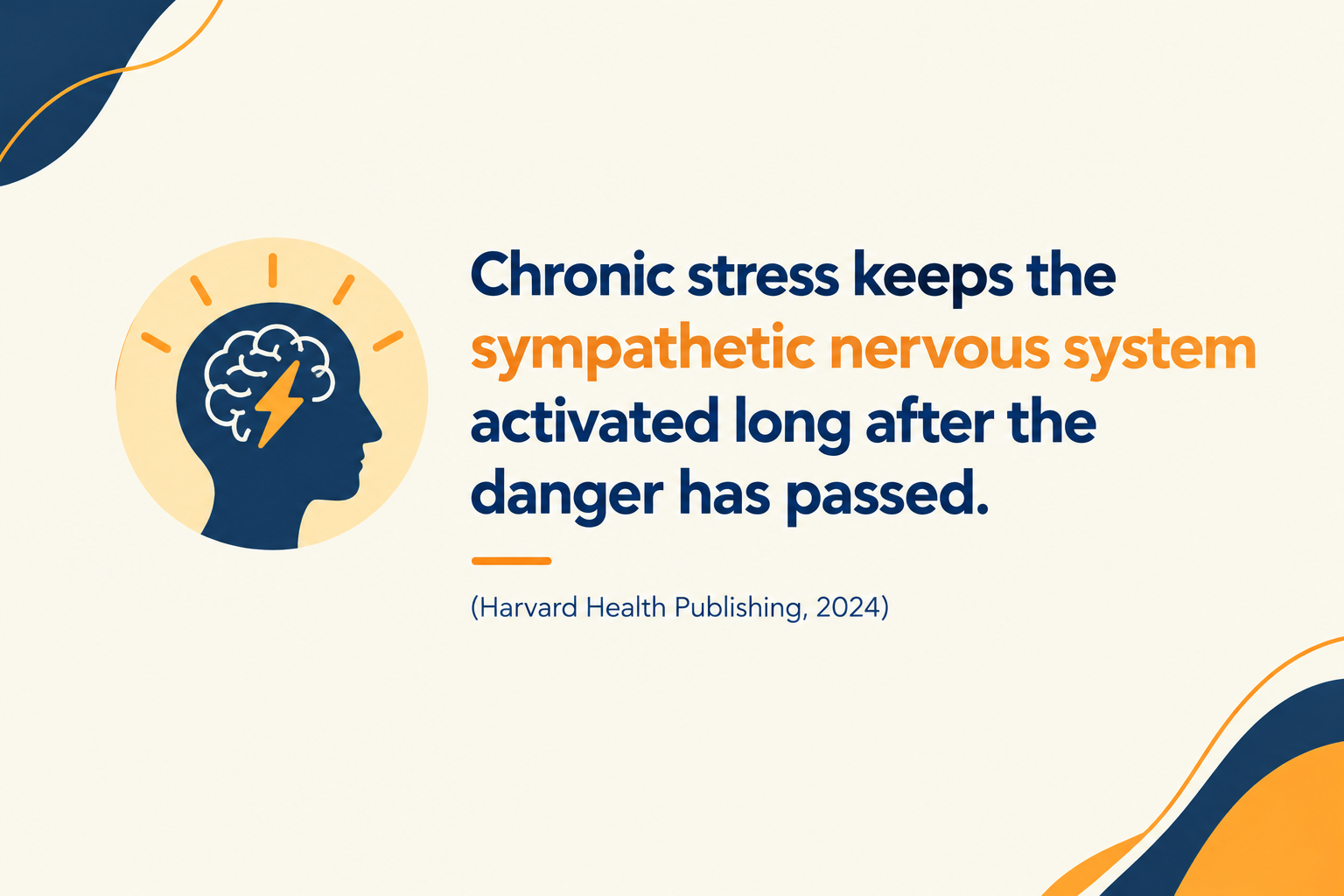
Slowing down often makes anxiety worse for a specific, physiological reason: your nervous system has been using pressure as fuel, and pulling that fuel away too fast can feel like removing the thing that's been holding you together. When someone spends years managing risk and carrying responsibility for outcomes, their stress response stays switched on even once the actual threat has passed. This isn't a mindset issue. The amygdala keeps signalling danger and the sympathetic nervous system keeps the body activated long after the meeting ends, because it hasn't been given a reason to stand down (Harvard Health Publishing, 2024).
I worked with a founder convinced she'd lost her personality. She used to be spontaneous and funny. Now she just felt flat, all the time. She was running a growing business, managing a team, supporting ageing parents overseas, and carrying most of the emotional load at home. Her nervous system hadn't switched off in years, so it no longer knew how, even on a quiet Sunday. This tracks with the research more broadly: a diffuse sense of self under sustained pressure doesn't just increase stress in the moment, it makes recovering from that stress considerably harder (Xiang, Teng, Li, & Chen, 2023).
That's why slowing down doesn't feel like relief for a lot of high achievers. It feels like exposure, because without the pressure to perform against, there's nothing left to hide the gap between who you're being and who you actually are.
How do you know if the “you” showing up every day isn't really you?
You know the version of you showing up daily isn't really you when you're functioning perfectly on the surface while feeling almost nothing underneath it. You deliver the presentation, answer your child's question, nod through the meeting, and none of it lands emotionally. You're present in the room but absent in the way that actually counts.
Other signals show up in quieter moments. Someone asks what you do for fun at a dinner party and you genuinely freeze, unable to remember the last time you did something that wasn't productive or expected of you. You've become more guarded or more risk averse than you actually are, and you can't pinpoint when that shift happened. You've been performing a reliable, capable, together version of yourself so consistently that you've lost track of where the performance ends and you begin.
None of this means something is wrong with you. It means a version of you got built to cope with sustained pressure, and it's been running on autopilot long after it stopped being necessary. [7 Identity Patterns Wiring You for Burnout goes deeper into where these patterns come from, including the ones formed long before you had any say in the matter.
What are the 5 questions that separate who you are from who you've become?
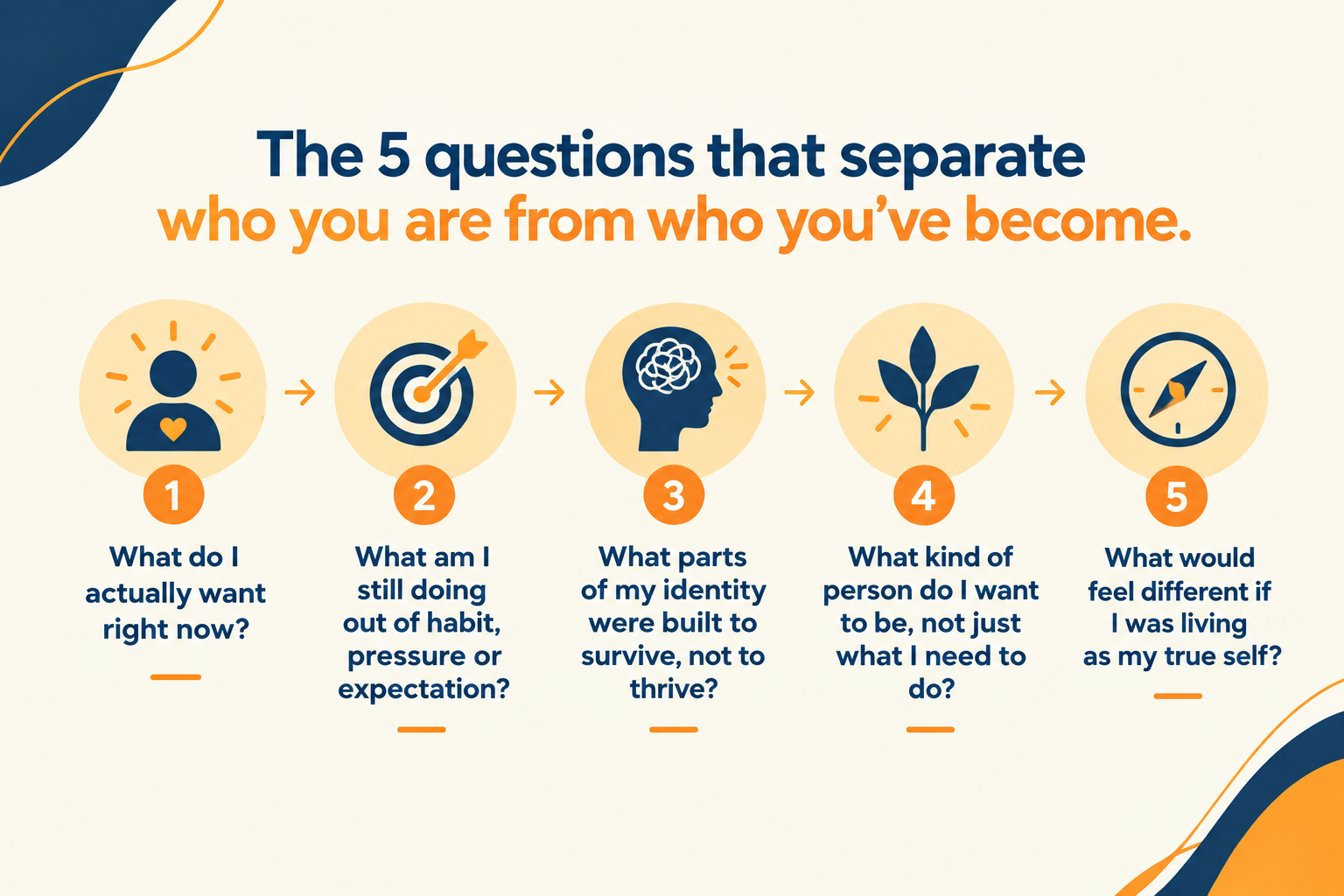
Five questions, worked through honestly, start to separate who you actually are from who you've become in order to survive.
Question 1 is simple to ask and hard to answer: who are you, underneath the title, the role, and what you do for other people? Strip all of that away and notice what's actually left. Are you funny, curious, adventurous, calm, a free spirit? Most people haven't asked themselves this in years.
Question 2 asks what you've blindly absorbed. Which beliefs and identity patterns did you pick up from your industry, your upbringing, or your environment without ever consciously choosing them, and which of those no longer serve who you are now? These patterns creep in quietly, until one day you're living by a set of rules you never actually agreed to.
Question 3 is what genuinely isn't you. Of everything you're currently carrying, which parts feel like a mask rather than the real thing?
Question 4 asks who comes out when you're energised. Think back to a time you felt most alive and most naturally yourself. That version of you is still in there, and it's likely waiting for permission to come back.
Question 5moves you forward rather than back. Picture yourself decades from now, at the end of a long life. What is that version of you feeling, saying, and doing? What does that tell you about who you actually want to become, starting from here?
Why lifestyle changes stall out if the identity work hasn't happened first
Lifestyle changes stall out because they're being made by the same version of you that burned out in the first place, and that version was never built for sustainability. You can fix your sleep, improve your habits, and set better boundaries, and still slip back into the same pattern within a few months. The habit was never the problem. The identity underneath it was.
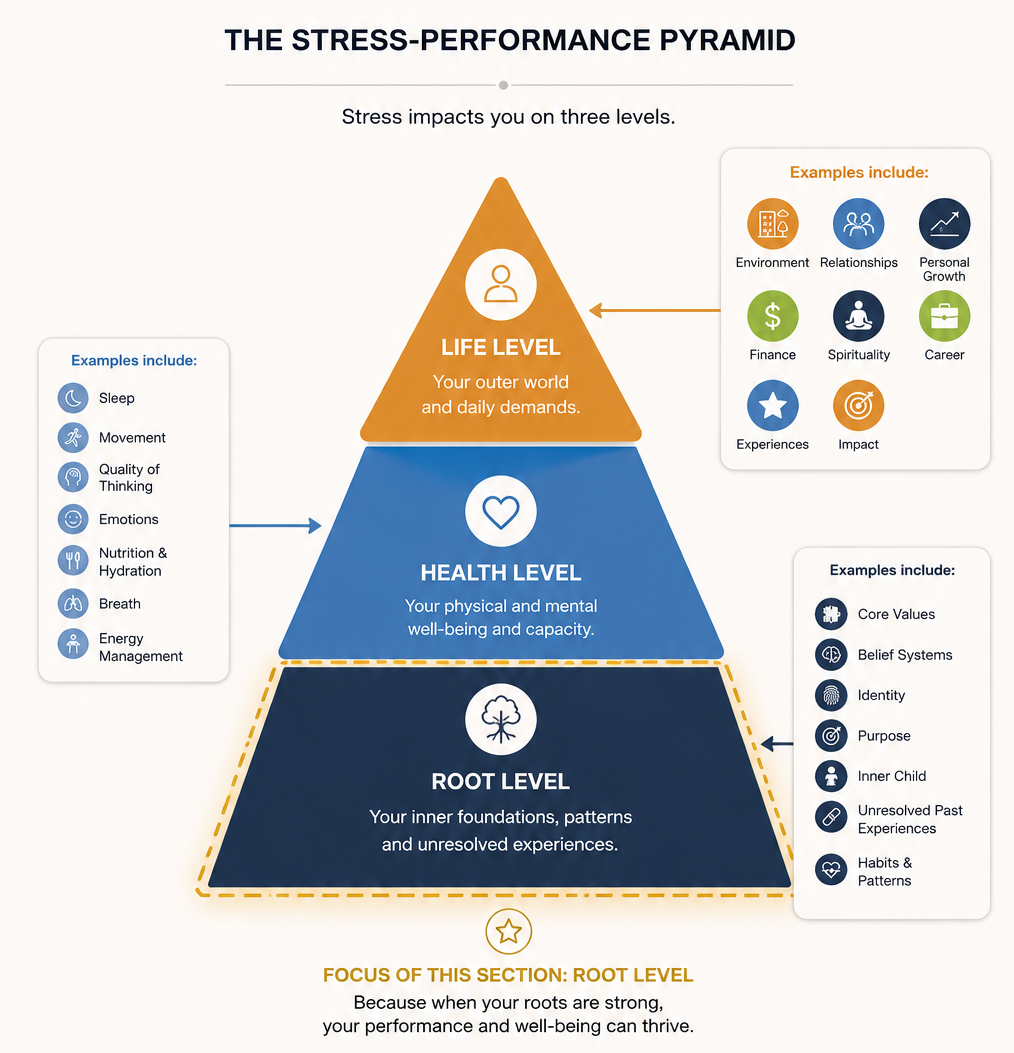
This is exactly what the Root Level of the Stress-Performance Pyramid addresses. Most interventions work at the Life Level, the visible external pressures like workload and deadlines, or the Health Level, the physical and emotional symptoms like exhaustion and irritability. Almost none touch the Root Level, the deeper identity patterns and nervous system conditioning actually generating the stress. Manage the Life Level and soothe the Health Level indefinitely, and the Root Level will keep producing the same exhaustion, wearing a different lifestyle around it.
When the identity work happens first, something shifts that no habit tracker can replicate. The boundaries you set stop feeling like a fight, because they're coming from someone who knows what they need. Rest stops triggering guilt, because you're no longer performing a version of yourself that equates stillness with falling behind. Once you know who you are, the habits finally have somewhere stable to land.
Frequently Asked Questions
What is identity-driven burnout?
Identity-driven burnout is exhaustion caused by sustaining a version of yourself built through pressure, expectation, or unconscious conditioning rather than genuine choice. It shows up even when your lifestyle looks manageable on paper, because the exhaustion isn't coming from your workload. It's coming from the ongoing cost of maintaining a self that was never fully yours to begin with.
Why does slowing down feel worse for high achievers?
Many high achievers have spent years using pressure and responsibility as a kind of fuel, so their nervous system adapts to that state as its baseline. When the pressure lifts suddenly, the system doesn't register it as relief. It registers it as the loss of the thing that's been holding everything together, which often shows up as anxiety rather than calm.
Can you burn out without losing anything tangible?
Yes. Identity-driven burnout doesn't need a job loss, a breakup, or any obvious life event to trigger it. It can happen while your life is ticking over exactly as planned, because the loss isn't external. It's the quiet erosion of your own sense of self underneath a life that, from the outside, looks like it's working.
How is this different from ordinary workload burnout?
Workload burnout responds to rest, reduced hours, and better boundaries, because the exhaustion is proportional to how much you're carrying. Identity-driven burnout persists after all of those changes, because the driver isn't the volume of work. It's the identity you built to manage that work, and it stays in place long after the workload eases.
What if I don't know who I am outside my role?
That's an extremely common starting point, not a sign that something is broken. Most people who've spent years in high responsibility roles have genuinely lost touch with who they are underneath the performance, simply because there's been no space for anything else to surface. The five questions in this article are a starting point for reconnecting with that, gently and honestly, rather than all at once.
Most people trying to recover from burnout focus almost entirely on physical fixes: sleep, food, exercise, boundaries. Those matter, but the psychology underneath them gets overlooked far too often. Identity is foundational. When you know who you are, everything else finally has somewhere to land.
Take a Free Stress-Less Scorecard
If any of this is landing for you, a good next step is getting clear on where your own stress and identity patterns are showing up right now. The free [INTERNAL LINK: Stress-Less Scorecard] takes about five minutes and maps your stress across your life, your health, and the deeper root drivers most people never think to look at.
And if what you're noticing feels like it's been there your whole life rather than something that developed recently, that's worth taking seriously rather than pushing through alone. That's precisely the kind of pattern the [INTERNAL LINK: Human Blueprint Coaching] work is built to address, at the Root Level, with someone who understands both the psychology and the nervous system underneath it.
About Charlotte Stebbing-Mills
Charlotte Stebbing-Mills is an award-winning wellbeing and performance expert with over 20 years of experience working with high performers, executives, and organisations across stress optimisation, burnout recovery, and sustainable high performance. She is the founder of The Wellness Theory and creator of the Stress-Performance Pyramid, the Well-Working Ecosystem, and the Ripple Effect Model.
Website: thewellnesstheory.com
Stress-Less Scorecard | Book an Exploration Call