
Why Responsible People Burn Out Differently (And What Actually Breaks the Cycle)
The most responsible person in the room is usually the one closest to burning out. She sat across from me and said, I don’t know how I got here. I’ve always been the one people rely on. Now I feel like a burden. Then she said the thing I hear in nearly every version of this conversation: I thought I was the only one. She wasn’t. Why responsible people burn out differently comes down to one thing. Their exhaustion isn’t a failure of discipline or self care. It’s the direct cost of a self concept that fused identity with dependability so completely that stopping ever feels like betrayal rather than protection. That’s why generic burnout advice rarely holds for this group, and why real recovery has to go further than learning to regulate yourself. It has to include the system generating the pressure in the first place.
Why does being “the responsible one” set you up to burn out differently?
Being the responsible one changes the psychology of stress completely, because responsibility stops working as a behaviour and starts operating as an identity. For some people that shift comes through a season of life, a leadership role or becoming a parent. For others it starts earlier, through childhood patterns like overachievement, people pleasing or caretaking, or through a mission that gradually became their whole identity. Wherever it starts, the outcome is the same. Responsibility stops being something you do and becomes something you are.
Think about the difference between wearing a coat and having it sewn into your skin. A coat comes off when you need to rest. But once responsibility becomes part of your identity, putting it down doesn’t feel like a choice. It feels like losing a piece of yourself. In over twenty years of working with founders, leaders and purpose driven professionals, I’ve watched this pattern show up almost every time, because the thing that made someone capable is the same thing quietly wearing them down. They’ve framed it as service and commitment, which is exactly why it doesn’t look like burnout from the outside. It looks like strength.
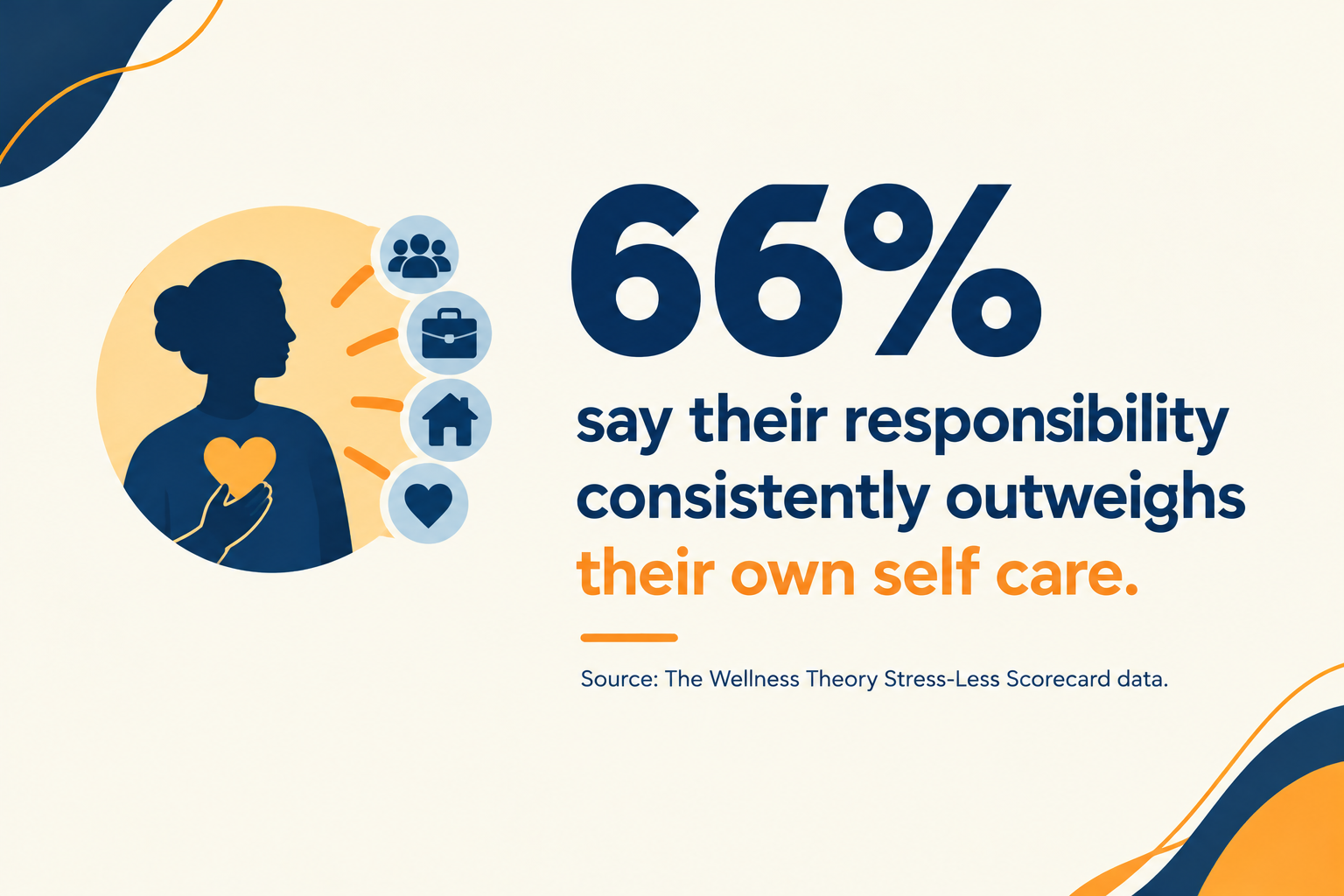
In Scorecard data from over 1,000 high responsibility professionals, 66% said their sense of responsibility consistently outweighs their own self care.
This is the trap. When meaning gets woven into identity this tightly, looking after yourself stops feeling like self care. It starts feeling like abandoning your own values. That single misunderstanding is what sets responsible people up to burn out differently, and it’s why they’re usually the last person anyone, including themselves, thinks to check in on.
What are the six stages of the responsibility burnout cycle?
There’s a predictable pattern that almost every high responsibility person moves through, and once you can see it, you can locate exactly where you are inside it.
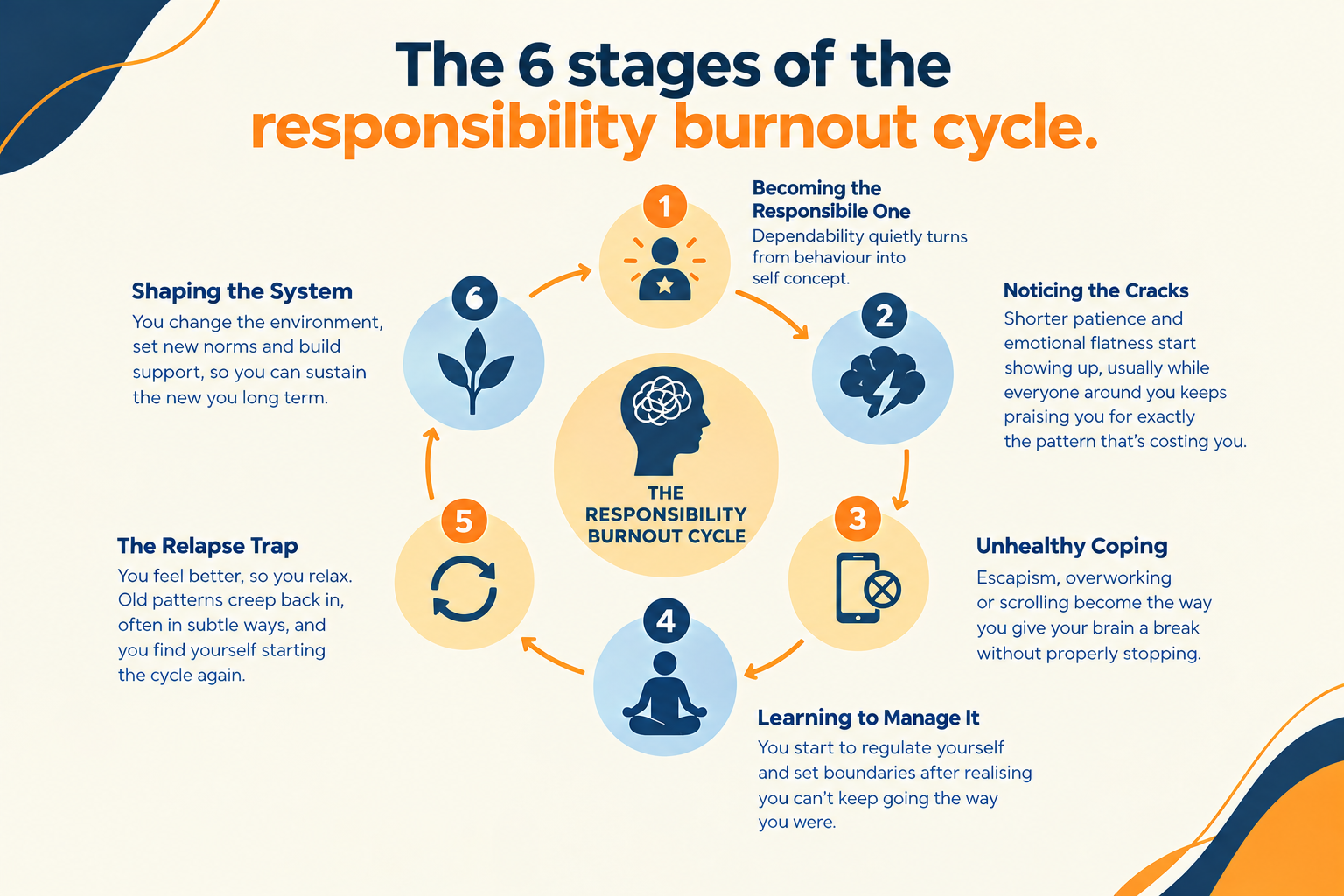
The first stage is becoming the responsible one, when dependability quietly turns from behaviour into self concept. The second is noticing the cracks, when shorter patience and emotional flatness start showing up, usually while everyone around you keeps praising you for exactly the pattern that’s costing you. The third is unhealthy coping, where escapism, overworking or scrolling become the way you give your brain a break without properly stopping. The fourth is where the real work begins, learning to regulate yourself and setting boundaries after realising you can’t keep going the way you were. The fifth is the one most recovery conversations skip over, and it decides whether the previous work actually holds. The sixth is the one most people never reach, and it’s the one that changes everything.
Most recovery advice stops at stage four, because stage four looks like success. You feel better, clearer, calmer. But feeling better at stage four isn’t the same as being finished, and the two stages after it are where the real transformation, and the real risk, live.
Why do you feel numb instead of overwhelmed once burnout becomes chronic?
Chronic burnout doesn’t usually feel like heightened overwhelm. It feels like almost nothing at all, which is precisely why it goes unnoticed for so long. The caring hasn’t stopped, but it’s stopped feeling like anything. You’re physically present at the dinner table, in the meeting, at the school play, while some quieter part of you has already left the room.
This tracks with the work of Stephen Porges, the researcher behind Polyvagal Theory, who describes an autonomic nervous system that shifts into protective states once pressure runs on for too long without proper recovery. Rather than becoming more reactive, it can move into a kind of shutdown, turning down the volume on connection, engagement and feeling itself, as a way of conserving whatever resource is left. In plain terms, the numbness isn’t emotional failure. It’s a physiological state your body enters when it’s been asked to stay switched on for too long without enough genuine recovery in between.
That distinction matters for responsible people, because the absence of visible distress gets mistaken for being fine. You never fully collapsed, so nobody, including you, names what’s actually happening. But feeling flat where you used to feel alive isn’t proof you’re coping. It’s usually the clearest sign your nervous system has been carrying more than it was ever designed to hold, for longer than it was designed to hold it.
Why do so many high performers relapse after they’ve already done the work?
High performers relapse because getting to the point of managing yourself well isn’t the same as removing the pressure that made you unwell in the first place. This is what I call the relapse trap, the point where someone has genuinely learned to regulate themselves and build healthier routines, and still ends up back in the exact same depleted state months later.
The responsibility load hasn’t gone anywhere. It’s still part of your work, your family and often your sense of who you are. So when pressure rises again, even after you’ve done the real work on yourself, it’s easier to quietly drop the healthy pattern than to keep protecting it under load. This isn’t evidence you didn’t learn the lesson properly. It’s what happens when the solution stayed entirely inside you while the system generating the pressure around you stayed exactly the same.
A longitudinal cohort study following employees back to work after burnout or depression found that fear of relapse was one of the most persistent barriers people faced, even well into their recovery. That fear exists for a reason. Most burnout advice assumes the individual is always the fix, so the moment life gets loud again, the very people who did everything right are left blaming themselves for why it’s happening again.
Why managing yourself isn’t enough: the stage most people skip
Managing yourself isn’t enough if the system you’re part of keeps generating more than any one person can absorb. This is stage six, shaping the system, and it’s the stage most people never reach, because it asks you to change something outside yourself rather than within you.
Those systems might be your family, your team or your wider workplace, anywhere you’ve quietly become the emotional or operational shock absorber. Dependable people often end up as the container for other people’s unresolved tension, whether that’s two colleagues who bring every disagreement to you instead of each other, or a household that’s learned you’ll handle whatever comes up so nobody else has to. None of that happened because anyone did anything wrong. It happened because the system learned you would carry it, and systems keep doing whatever already works for them.
This is essentially what my Well Working Ecosystem framework maps at an organisational level, the idea that wellbeing rarely fails because of one person’s resilience. It fails because leadership, workload, culture and psychological safety interact in ways that either support people or quietly overload them. The same principle holds true at a smaller scale, inside a family. If the structure around you keeps producing more than you were meant to hold alone, becoming brilliant at managing yourself will only get you back to stage five, not out of the cycle completely.
›
Think of it like a leaking tap. You can get better and better at mopping the floor, but until someone fixes the tap, the floor stays wet. Stage six is fixing the tap, and it usually starts with one honest, uncomfortable conversation you’ve been avoiding for months.
Frequently Asked Questions
Why do responsible, high achieving people burn out differently?
Because their sense of responsibility has become part of their identity, not a role they perform, so advice to rest more or set boundaries feels like abandoning who they are. Their burnout is driven by identity fusion and moral weight, not laziness or a lack of resilience.
What is the relapse trap in burnout recovery?
The relapse trap is the point where someone has genuinely done the work and built healthier routines, and still ends up back in a depleted state once pressure rises again. It happens because the responsibility load around them never reduced. The person changed. The system they were operating inside of didn’t.
Why do I feel numb rather than overwhelmed when I’m burned out?
Chronic stress can push the nervous system into a protective state that reduces feeling rather than intensifying it, described through Polyvagal Theory as a kind of shutdown response. Instead of panic, you experience flatness and distance, which is often why burnout in highly responsible people goes unnoticed for so long, even by themselves.
Can you burn out again even after learning to regulate yourself?
Yes, and it’s more common than most recovery advice accounts for. Regulating yourself changes how well you cope with pressure, but it doesn’t reduce the amount a system keeps generating. Without addressing that structural load, the conditions that caused the first burnout are usually still there.
What does it mean to fix the system, not just yourself?
It means recognising that some of what’s exhausting you isn’t a personal shortcoming but a structural pattern in your family, team or workplace that keeps producing more than one person can reasonably absorb. Fixing it might mean redistributing decisions or having a conversation you’ve been avoiding, the most uncomfortable step, and the one that finally makes recovery hold.
None of this is permanent damage, and none of it means something is wrong with you. It’s a recognisable, predictable cycle, which means there’s a way through it that doesn’t require becoming a different person or giving up the parts of yourself that made you good at what you do. It’s finally seeing that some of what you’ve been carrying was never yours to carry alone.
Take a Free Stress-Less Scorecard
If any of this landed and you want to get clearer on where you are in this cycle, the free Stress-Less Scorecard maps your stress across your life, your health and the deeper root patterns underneath both in about five minutes. If you recognise yourself in this pattern of holding everything together, Why Being “The Strong One” Is Burning You Out looks at the specific identity types this shows up as. And for support with the deeper root level and stage six work, Human Blueprint Coaching is where that happens one to one.
About Charlotte Stebbing-Mills
Charlotte Stebbing-Mills is an award-winning wellbeing and performance expert with over 20 years of experience working with high performers, executives, and organisations across stress optimisation, burnout recovery, and sustainable high performance. She is the founder of The Wellness Theory and creator of the Stress-Performance Pyramid, the Well-Working Ecosystem, and the Ripple Effect Model.
Website: thewellnesstheory.com
Stress-Less Scorecard | Book an Exploration Call