
Why Rest Doesn’t Fix High-Performer Burnout
You’ve taken the time off. Switched your phone away, slept properly, done everything you were told would help. By day three back at your desk, the tightness is sitting exactly where you left it. If you’re asking why rest doesn’t fix burnout for people who are still high performing, still reliable, still the one everyone turns to, here’s the honest answer: rest treats the tiredness, not the reason you got tired in the first place. In nearly two decades working in stress physiology and performance, I’ve watched hundreds of high capacity leaders take genuine time off, come back changed for about a week, then quietly slide back into the same grip. Rest lowers your output. It doesn’t touch identity, values, or the emotion you’ve spent years learning to contain. This article walks through the three root patterns behind the exhaustion, and how to tell which one is running the show for you.
Why Burnout is Often an Identity Problem, Not a Fatigue Problem
Burnout is often an identity problem, not a fatigue problem, when the tiredness lifts but the tightness doesn’t. I worked with a founder who took two weeks off in Italy this year. No laptop, no meetings, a genuinely beautiful place to rest. He came home physically recovered. Within forty eight hours the tightness was back, and it had nothing to do with his workload. It came from who he believed he had to be. His sense of worth was fused to his output, so when he wasn’t producing he felt unsettled, and when he wasn’t needed he felt replaceable. Rest had paused his activity. It hadn’t touched his identity.
I know this pattern from the inside. Earlier in my career I wore being the dependable one like armour, and letting go of it felt indistinguishable from letting people down. That belief kept me operating in overdrive long after my body had asked for something different.
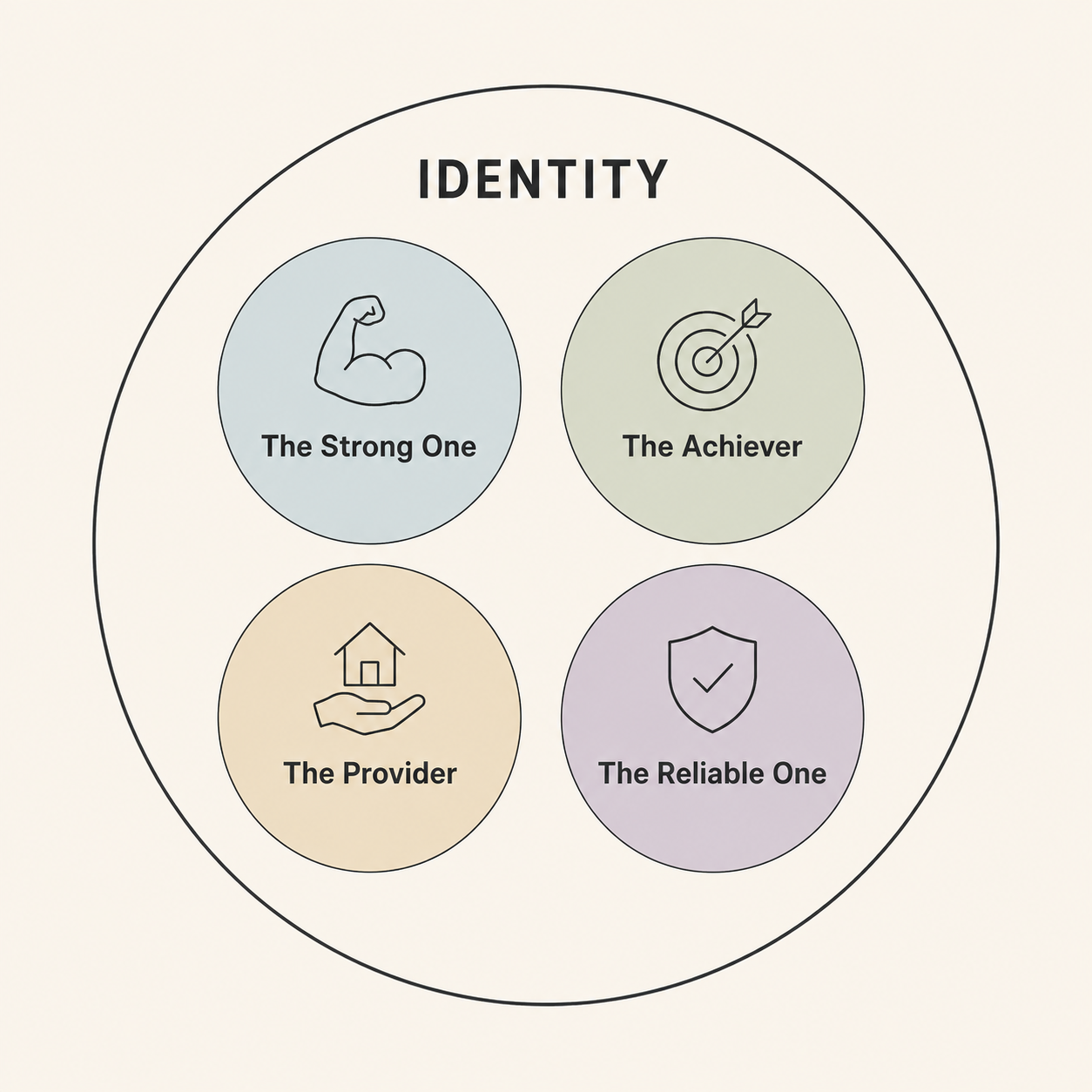
Psychologists call this role engulfment: when one role, whether that’s the strong one, the achiever, the provider or the reliable one, expands until it swallows the rest of your identity, so that losing momentum in that role feels like losing yourself entirely. For a lot of men specifically, that role is provider. Suicide remains the leading cause of death for men under fifty in the UK (Samaritans, 2026), and while the causes behind that statistic are always layered, one thread running through it is worth being honest about: when your worth becomes fused with your output, slowing down can start to feel like failure rather than recovery. Rest can lower your activity level, but it can’t loosen the grip of a role you haven’t questioned, and that’s part of why rest doesn’t fix burnout when the burnout is actually about identity.
Why Values Misalignment Quietly Drains Energy Rest Can’t Reach
Values misalignment quietly drains energy that rest can never reach, because the drain isn’t coming from how hard you’re working. It’s coming from a contradiction you’re living inside every day. I stayed in a leadership role far longer than was healthy because I valued loyalty and integrity, and the organisation said it valued the same things. Its actions told a different story. Decisions at the top kept harming junior staff, and as a leader I absorbed the fallout every time. My calendar was full, my output was strong, and my energy was gone. For a long time I thought the answer was more resilience. It wasn’t a capacity problem. It was a values violation, and once I named it, everything changed.
Values misalignment is what happens when what you say matters and what you actually do stop lining up, and your body notices the gap long before your mind puts words to it. You say your health matters, then cancel every workout. You say family comes first, then answer email at dinner. Psychologists call the discomfort this creates cognitive dissonance, and research on burnout consistently finds that a mismatch between personal and organisational values is one of the strongest predictors of exhaustion and cynicism at work, often outweighing workload itself (Maslach and Leiter, 2016). Living against your own values is like running on a treadmill set to someone else’s speed. You might be fit enough to keep up. That was never really the question.
Rest removes you from the environment. It doesn’t resolve the contradiction waiting for you back inside it. If burnout keeps returning once you’re back in the room, it usually isn’t the workload, and that’s a big part of why rest doesn’t fix burnout on its own. Misalignment is solved with an honest look at where your actions and your values have quietly stopped agreeing.
Why suppressed emotion keeps the nervous system on edge
Suppressed emotion keeps the nervous system on edge because what doesn’t get processed doesn’t disappear, it converts into something else entirely. High performers are usually excellent at containment. You absorb pressure, override frustration, minimise resentment and push through disappointment, and from the outside that looks like maturity. Underneath, resentment tends to become withdrawal, frustration becomes a shorter fuse, and chronic pressure becomes a need to control everything around you. None of that shows up as sadness. It shows up as permanently on edge.
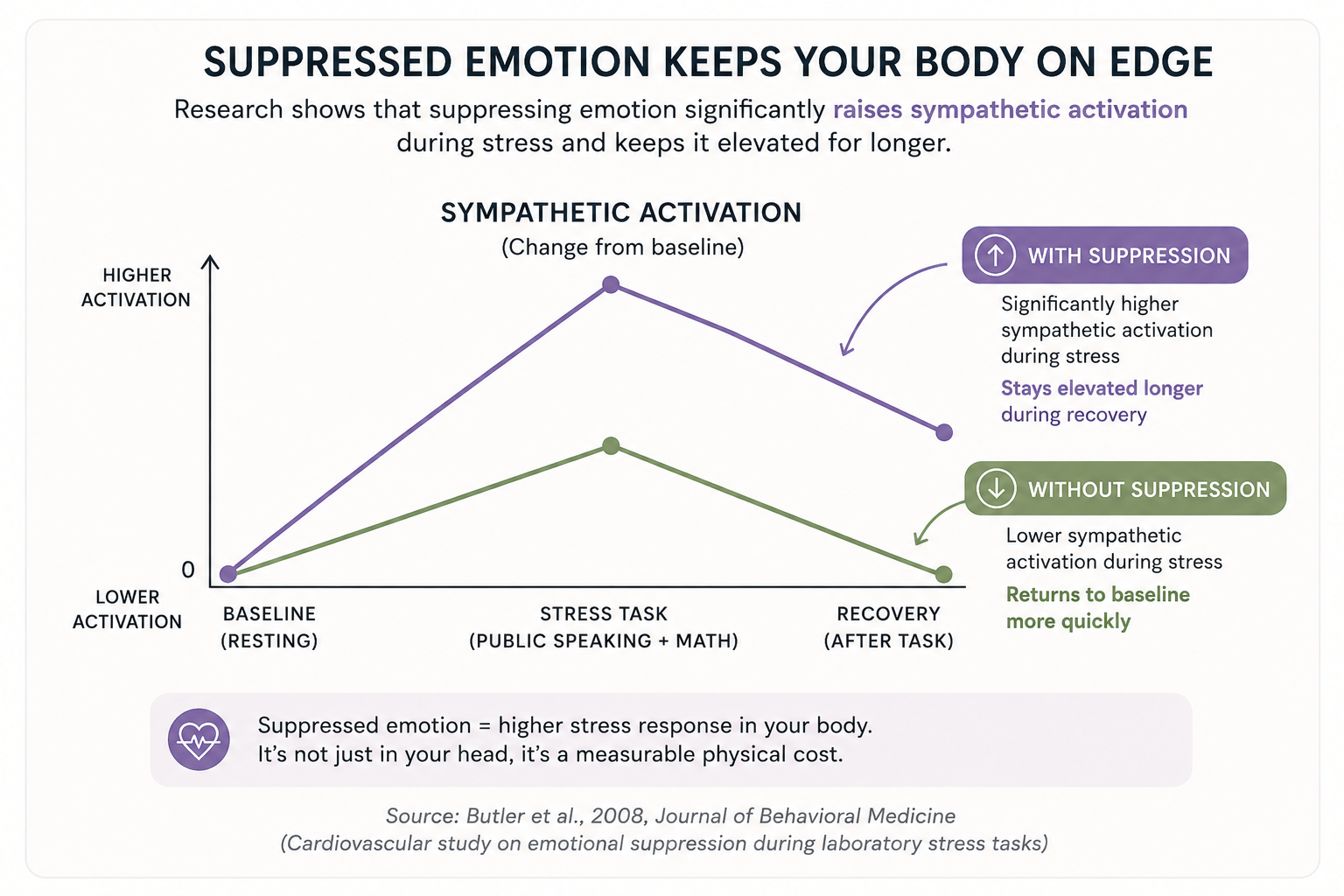
When emotion stays suppressed for long enough, your nervous system stops fully resetting between one demand and the next. Your baseline sits slightly elevated all the time, your thinking narrows under pressure, and your tolerance for small irritations drops. This carries a measurable physical cost, not just an emotional one. Research on emotional suppression has found it raises sympathetic activation of the cardiovascular system, driving up blood pressure during stress and keeping it elevated for longer afterwards, an effect that holds regardless of age or gender (Butler et al., 2008).
The loop tends to look the same for most high performers: push hard, hit the edge, take a break, feel briefly better, then rebuild the same standards and the same overfunctioning. That isn’t weakness, it’s wiring. If you learned early that being valuable meant being useful, you’ll keep designing your leadership around being indispensable, and rest interrupts that behaviour without rewriting the belief underneath it.
How To Tell If Your Burnout is Root Level
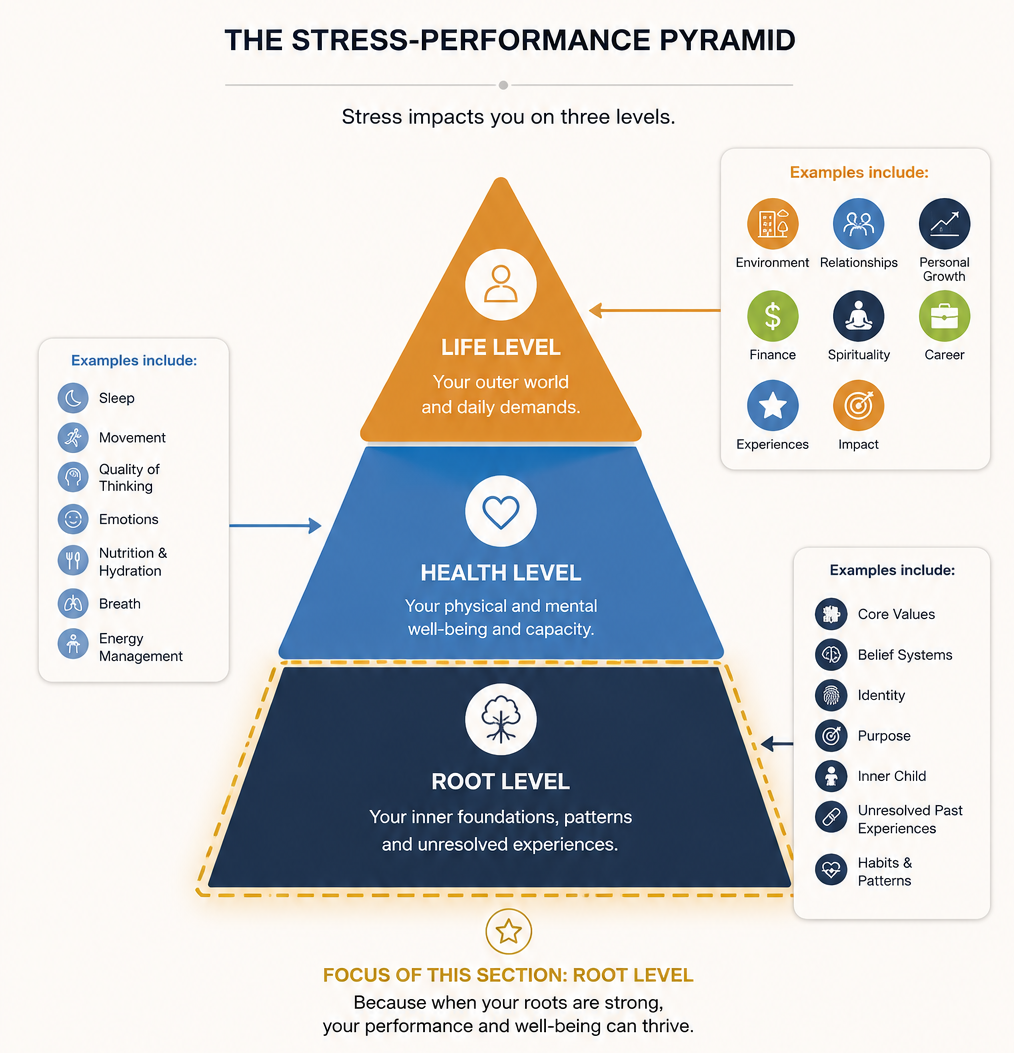
You can tell your burnout is root level by checking whether the exhaustion moves when your circumstances do. This is what I map with clients using the Stress Performance Pyramid, a framework with three layers. Life Level stress is the visible pressure, the deadlines and meetings you could point to on a calendar. Health Level stress is what that pressure does to your sleep, your body, your patience. Root Level stress is the deepest layer, the identity, the values and the suppressed emotion that keep the whole system activated no matter what the calendar says. Most attempts at recovery, including rest itself, work at the Life Level. They change the input without touching the layer that’s actually running the pattern.
At the Root Level, safety and performance get fused together. You over deliver, hAsk yourself three honest questions. Did the exhaustion lift when the workload dropped, or did it stay the same underneath a quieter schedule? That tells you whether you’re looking at fatigue or something deeper. Do you feel unsettled the moment you’re not producing, even when nothing is actually wrong? That points towards identity rather than tiredness. And is there a specific conversation or decision you’ve been avoiding because naming it honestly would mean admitting something doesn’t sit right with you? That’s usually where the misalignment or the suppressed emotion is hiding.
If your answers point past the surface, rest was never going to be enough on its own, and that isn’t a failure of willpower. It’s a sign you’ve been treating a root level pattern with a Life Level solution.
Frequently Asked Questions
What’s the difference between ordinary fatigue and identity driven burnout?
Fatigue usually lifts once you rest and the workload eases. Identity driven burnout doesn’t move the same way. You can feel physically rested and still carry a tightness that returns within days, because the exhaustion was never really about hours worked. It’s about who you believe you have to be to stay safe, useful or valuable, and that belief doesn’t take a holiday just because you do.
What does values misalignment actually feel like day to day?
It rarely feels dramatic. It shows up as small, repeated contradictions between what you say matters and what your calendar actually does, saying health comes first while missing every workout, or saying family comes first while checking email at dinner. Most people notice the tiredness long before they notice the contradiction underneath it, which is why values misalignment so often gets mistaken for a workload problem.
Why does suppressed emotion carry a physical cost, not just an emotional one?
Emotion that gets contained rather than processed still moves through your body, it just moves through your nervous system and cardiovascular system instead of through expression. Research has linked sustained emotional suppression to raised sympathetic activation and higher blood pressure during and after stress. Your body keeps the score even when your calendar looks calm.
Can you feel fully rested and still be burned out?
Yes. Everything you were told to do, sleep properly, switch off, take genuine time away, can work at the surface level while root level burnout sits underneath it in identity, values and unprocessed emotion. Sleeping well and still feeling the same dread on a Monday isn’t a contradiction. It’s a sign the real driver hasn’t been addressed yet.
What is role engulfment, and why does it matter for burnout?
Role engulfment is what happens when a single role, the strong one, the achiever, the provider, expands until it becomes almost your entire identity, crowding out every other version of who you are. Once that happens, losing momentum in that role doesn’t just feel inconvenient, it feels like losing yourself, which is why so many high performers push through exhaustion long after their body has asked them to stop.
If rest hasn’t worked for you, it was never a sign you don’t know how to recover. It’s a sign you’ve been aiming recovery at the wrong layer. Some burnout genuinely responds to time off. The kind rooted in identity, values and suppressed emotion responds to something else entirely, and that’s why rest doesn’t fix burnout for so many high performers, no matter how properly they do it.
Take a Free Stress-Less Scorecard
If you want clarity on where your own burnout is actually coming from, the Stress and Performance Scorecard will show you in about three minutes. It’s built to show you whether this is surface fatigue or a deeper root level pattern, so instead of guessing whether you need another holiday or something that actually addresses what’s underneath, you’ll know.
About Charlotte Stebbing-Mills
Charlotte Stebbing-Mills is an award-winning wellbeing and performance expert with over 20 years of experience working with high performers, executives, and organisations across stress optimisation, burnout recovery, and sustainable high performance. She is the founder of The Wellness Theory and creator of the Stress-Performance Pyramid, the Well-Working Ecosystem, and the Ripple Effect Model.
Website: thewellnesstheory.com
Stress-Less Scorecard | Book an Exploration Call