
Why the Things You Used to Love Suddenly Feel Hollow
You used to love this. The business you built, the work you chose, the hobby that made weekends feel like your own again. Somewhere along the way, without a single moment you could point to, it stopped. If you don’t enjoy the things you used to love anymore, and resting more, cutting your screen time, or forcing yourself back into the old routine hasn’t touched the flatness underneath, this is why. It isn’t a sign that you’re lazy, ungrateful, or quietly broken. It’s a signal, and once you understand what it’s pointing to, you can stop fixing the wrong thing.
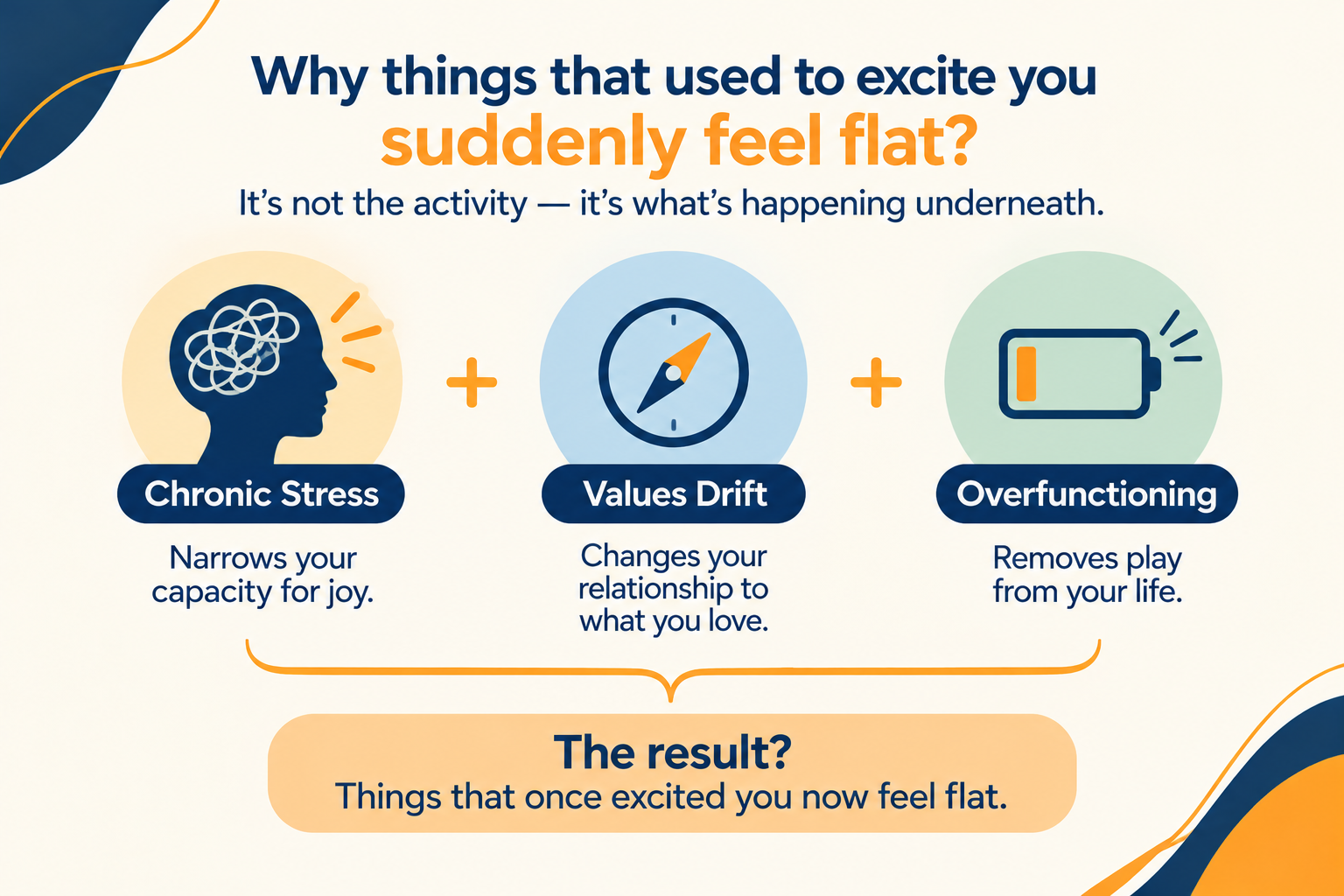
Why do things that used to excite you suddenly feel flat?
Things that used to excite you feel flat because something underneath has changed, not because the thing itself lost its value. In over twenty years of working with high achievers, founders, and executives, I’ve seen this pattern repeatedly, and it’s almost always a combination of three things: chronic stress narrowing your capacity for joy, what I call values drift quietly changing your relationship to the thing you love, and overfunctioning removing play from your life.
This is different from ordinary tiredness. You’re still functioning, still delivering, but the internal experience of doing the things you used to love has gone quiet, and because you can’t name a single cause, you start to wonder if something in you has permanently changed.
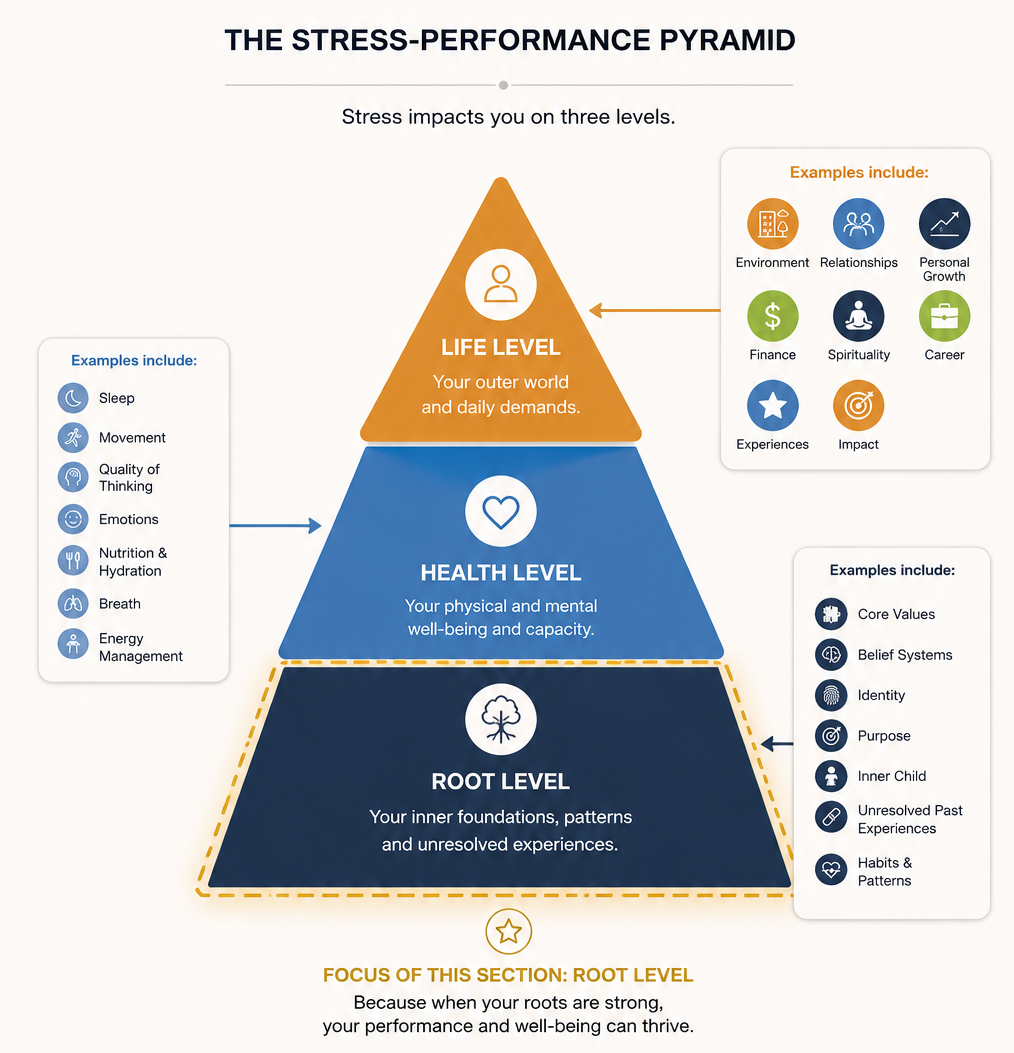
I map this using what I call the Stress-Performance Pyramid, a framework across three levels. Life Level is the external pressure: your workload, your responsibilities, your circumstances. Health Level is what that pressure does to your body and mood. Root Level sits underneath both, the behavioural patterns and nervous system conditioning that sustain the stress. Most advice you’ve already tried works at the Life Level, telling you to change your circumstances or habits. But losing your capacity for joy is a Root Level signal, which is why Life Level fixes rarely touch it.
How does chronic stress narrow your capacity for joy?
Chronic stress narrows your capacity for joy because sustained cortisol elevation suppresses activity in the prefrontal cortex, the part of the brain responsible for curiosity and feeling reward, while also reducing dopamine signalling in the brain’s reward circuitry. This isn’t a metaphor. It’s a measurable shift driven by the brain switching into survival mode and prioritising threat detection over exploration and pleasure (Arnsten et al., 2015). Related research on the dopaminergic reward system shows the same pattern, with chronic stress reducing dopamine activity in the circuitry that generates anticipation and motivation for things we’d normally enjoy (Baik, 2020).
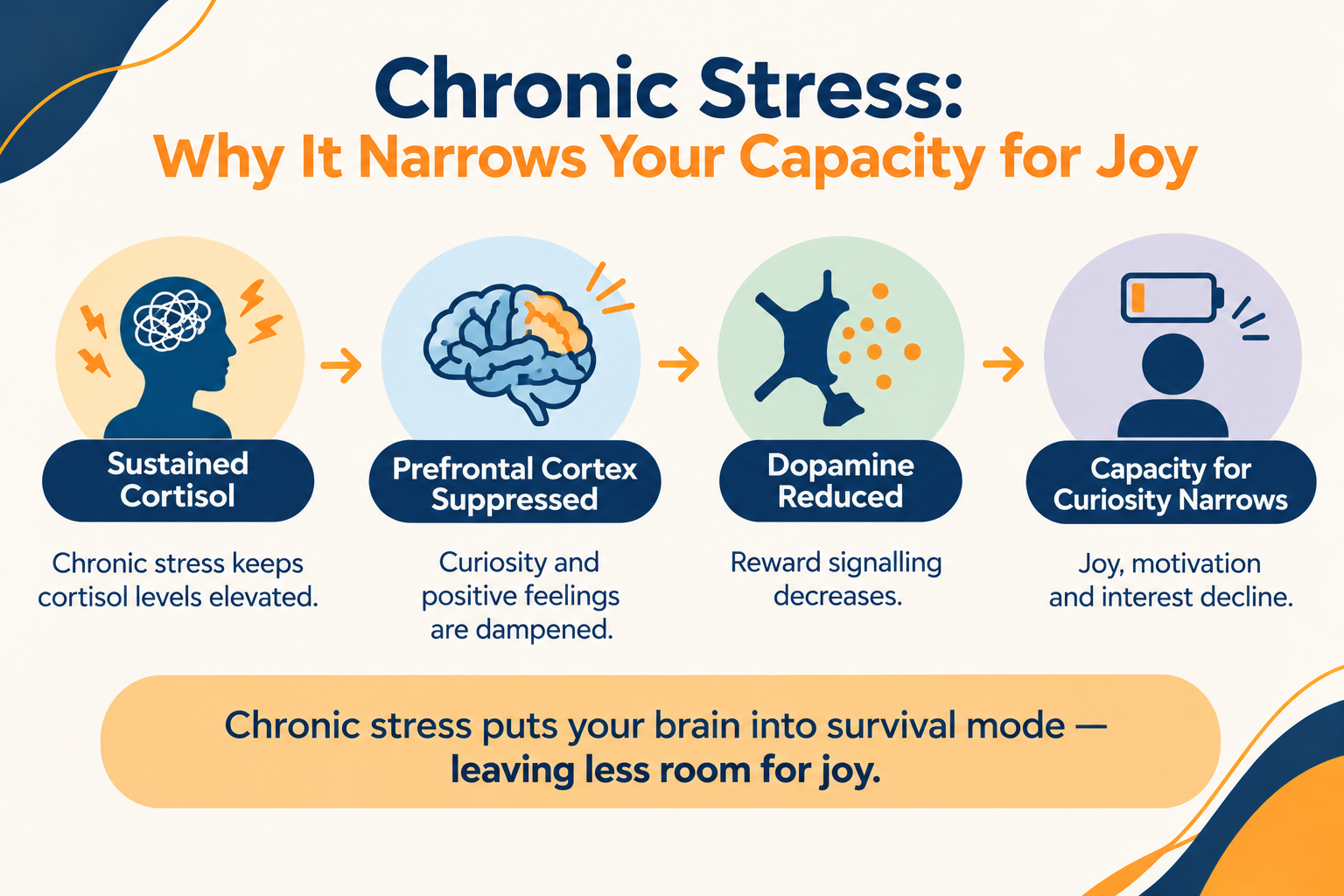
When the thought “I just don’t care anymore” shows up, what’s actually true is closer to this: your nervous system doesn’t currently have the spare capacity to be curious or feel joy the way it once could. That’s a different problem to being lazy, and it points to a different solution. You can’t willpower your way back into curiosity while the system is still in survival mode. You have to reduce what’s keeping it activated first.
I once worked with a senior NHS leader convinced she’d fallen out of love with her career. “I don’t think I want this anymore,” she told me. What we found instead was that she hadn’t changed at all. Chronic stress had closed down her capacity to feel much beyond urgency. Once she began reducing the load, the passion returned. Not immediately. But it came back.
This is closely related to anhedonia, a markedly diminished capacity to experience pleasure across activities a person would normally enjoy (Serretti, 2023). It’s most commonly discussed as a symptom of depression, and if what you’re feeling is persistent and affects most areas of your life, it’s worth speaking to a GP or mental health professional. But what I see most in high performing clients isn’t clinical anhedonia. It’s a nervous system so chronically activated it has temporarily lost the bandwidth for reward, which shifts once the load changes.
What is “values drift,” and why does it make success feel empty?
Values drift is what happens when an activity that once met a genuine psychological need, creativity, connection, contribution, purpose, stays the same on the surface while everything around it quietly changes, until the activity is still present but the meaning has gone. Most high responsibility people don’t lose interest because of dopamine or screen time. They lose interest because the thing they loved became a responsibility they carry rather than a choice they make.
A founder who once loved building ends up spending her days in spreadsheets and management meetings. A nurse who came into the profession to care for people ends up carrying the emotional weight of an entire ward. A parent who adores their family ends up so buried in logistics that presence gives way to management. The activity hasn’t changed. The relationship to it has, and that’s the part nobody names.
This differs from anhedonia in one way. Anhedonia is a general loss of the capacity to feel pleasure. Values drift is more specific: the activity has kept going, sometimes for years, while the need it used to meet was slowly replaced by obligation. You can still feel pleasure elsewhere and still experience values drift in the one area that used to define you.
If you carry responsibility not just for your own output but for a team, a cause, or people depending on you, this pattern often runs deeper. [INTERNAL LINK: Why Responsible People Burn Out Differently] looks at why responsibility changes the shape of burnout and why the usual advice tends to miss it.
How does overfunctioning quietly remove play from your life?
Overfunctioning removes play from your life because when every activity becomes tied to an outcome, a metric, or a responsibility, nothing is left that exists purely for its own sake, and play is exactly what allows curiosity and presence to return. Once that happens, even things that were never meant to be productive start to feel like one more thing to perform.
I worked with a founder in her late thirties running a small, growing social enterprise. From the outside she was doing well. But she couldn’t remember the last time she’d done anything that wasn’t for the business, the team, or the mission. Her weekends had become catch up time. Even time with her children had started to feel like something to manage rather than simply be inside of.
Once she understood her stress pattern and where her values had drifted, she made one decision that shifted things. She hired someone into the business so she could stop doing the parts quietly draining her, return to the work that had drawn her in, and create real space for her family. It wasn’t the easy call. It was the aligned one. Afterwards she told me: “I didn’t realise how much I’d stopped being a person. I’d just become a function.”
What actually helps you feel joy again, without forcing it
What actually helps is not resting more or forcing your way back into old hobbies. It’s reducing what’s keeping your system chronically activated, realigning with what genuinely matters now, and doing at least one thing purely because it makes you present, not because it’s productive.
Start with the first one honestly. Ask what is constantly activating stress in your system right now. It might be your phone, though for most people it runs deeper: a person, a project, or an invisible load at home nobody has acknowledged. Find one thing you could genuinely reduce, remove, or share.
Then look at realignment. Ask what is actually most important to you right now in your relationships, your work, your health, not what you feel it should be. When joy fades, it’s often because time and energy have quietly drifted from what genuinely matters.
Finally, find one thing you do purely for its own sake, not for an outcome, just because it makes you present. For me, that’s painting. I’m not good at it, and I’m not trying to be. I put music on, stop thinking, and slowly, something shifts. This mattered enormously during my own recovery from burnout, and I see the same thing with clients again and again. You don’t force joy back. You create the conditions for it, and it returns on its own timeline.
Frequently Asked Questions
What does it mean when you stop enjoying things you used to love?
It usually means your capacity for curiosity and reward has narrowed, most often because of chronic stress, a shift in your relationship to the activity, or both. It rarely means you’ve changed fundamentally. It’s a signal that needs attention, not evidence the thing you loved was never really you.
Is losing interest in hobbies a sign of burnout or depression?
It can be either, and the two often overlap. If the flatness is persistent and comes with low mood or changes in sleep and appetite, speak to a GP or mental health professional to rule out depression or clinical anhedonia. In high performing clients, it’s more commonly a chronically activated nervous system combined with values drift.
What is values drift?
Values drift is when an activity that once met a genuine psychological need, creativity, connection, contribution, or purpose, stays the same on the surface while the conditions around it change, so the meaning quietly disappears even though you’re still doing the thing. It’s why people keep showing up for years to work that no longer feels like their own.
Can you force yourself to feel joy again?
Not directly, and trying usually backfires, because forcing joy is another form of pressure on a nervous system already overloaded. What works instead is reducing what’s keeping your system activated and creating small conditions, like doing something purely for its own sake, that let curiosity return naturally.
Why do successful people often feel empty inside?
Because external success and internal capacity aren’t the same thing. You can build an impressive career while your nervous system quietly runs on survival mode underneath it, and while your relationship to the work has drifted from purpose into obligation. That gap is one of the clearest signs the Root Level, not the Life Level, needs attention.
If you don’t enjoy the things you used to love right now, that isn’t proof that something in you broke permanently, and it isn’t a verdict on the life you’ve built. It’s information: about how activated your nervous system currently is, where your relationship to the things you love has drifted, and how much room is left for anything that isn’t tied to an outcome. Once you see it that way, it stops being something to fear and starts being something you can work with.
Take a Free Stress-Less Scorecard
If you want a clearer picture of where your own capacity is being depleted, the Stress-Less Scorecard is a free assessment that takes a few minutes and shows you exactly where your stress is coming from. If this pattern has been running for a long time, I Thought Burnout Had Broken Me for Good goes further into what real recovery looks like. For those who want to work through this at a deeper level, is where we do that properly, at the root.
About Charlotte Stebbing-Mills
Charlotte Stebbing-Mills is an award-winning wellbeing and performance expert with over 20 years of experience working with high performers, executives, and organisations across stress optimisation, burnout recovery, and sustainable high performance. She is the founder of The Wellness Theory and creator of the Stress-Performance Pyramid, the Well-Working Ecosystem, and the Ripple Effect Model.
Website: thewellnesstheory.com
Stress-Less Scorecard | Book an Exploration Call